Sunday, October 1, 2017


Friday, July 3, 2015
5 Core Sales Concepts of Lean Thinking
When introducing Lean Thinking many of us would start with the five core concepts of Lean depicted in the classic books, The Machine that Changed the World and Lean Thinking by Womack and Jones.
The basic thought process goes something like this: As value is
specified, value streams are identified, wasted steps are removed, and
flow and pull are introduced. And we begin the process again and
continue it until a state of perfection is reached in which perfect
value is created with no waste.
5 Core Concepts of Lean Thinking:
- Identify Value
- Map Value Stream
- Create Flow
- Establish Pull
- Seek Perfection
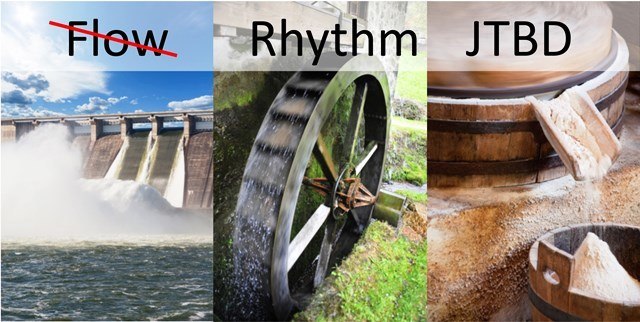
5 Sales Concepts of Lean Thinking
- Identify Value = Job To Be Done
- Map Value Stream = Customer Journey thru Use
- Create Flow = Rhythm
- Establish Pull = Adaptive, Agility
- Seek Perfection = Continuous Learning
Many wonder how to put this in practice and for a template I use the five phases of Agile Project Management by Jim Highsmith. I adapted his description to a marketing tone.
Envision. Speculate. Explore. Adapt. Close.
- Envision: Determine your marketing vision and objectives and constraints, your community, and how your team will work together.
- Speculate: develop the capability and/or feature based launch to deliver on the vision.
- Explore: plan and deliver running tested stories in the short iteration, constantly seeking to reduce risk and uncertainty.
- Adapt: review the delivered results, the current situation, and the team’s performance, and adapt as necessary.
- Close: conclude the launch, pass along key learning, and celebrate.
Friday, November 8, 2013
No Steve, Jack or Bill, just The Caterpillar Way
How many companies get Leadership right? Do you always have to have that charismatic leader that makes us think about them before the company? Tomorrow’s podcast is with Craig Bouchard, author of the book, The Caterpillar Way: Lessons in Leadership, Growth, and Shareholder Value. If you know my legacy a bit, you understand the high degree of interest.
An excerpt from the podcast:
Joe: What struck me about the book more than anything else is that there was not a Jack Welch, a Steve Jobs, or a Bill Gates. It was a credit to the entire Cat organization. Was that true? Is that how Cat is?
Craig Bouchard: I really confess. It's incredibly true. I've been the CEO for a couple of companies. I'm the CEO of Signature Group, a public company right now, in a great company. But in the case of Caterpillar, I've never seen such a large group of people so thoroughly dedicated in increasing their revenues and decreasing their expenses as a team - which is kind of simple - but what I'm trying to say is that it's rare in real experience. That company is really - everybody is on the same page and that's a management feat of course that they've accomplished that.
Joe: Yes it's a huge management feat but not to have that person out there waving the flag just amazes me.
Craig: Yes and when I look at Cat is and the most remarkable thing going back to the 80's. They had basically six incredibly large complicated decisions to change the company during this past thirty years. Six times, they turned the entire place upside-down strategically requiring such a flexibility of their management and their workforce - it's just really remarkable and each one of those decisions could have turned into a disaster and each one like them have turned into disaster for other companies, and Caterpillar went six-for-six. Basically with four different Chief Executive Officers through that time period responsible for those six decisions. Not only did they go six-for-six in decisions, they managed to get it right who was the right person to implement and come up with an implementation for each of them. This kind of a record is almost unheard of in terms of these types of gigantic decisions were implemented.
Joe: Did the CEOs get picked based on the needed initiative, or because they were good at, or did it happen because they were at that?
Craig: We talked about that a little bit in the book. How much of it is luck and how much of it is that the board of directors, they had at the time, picked the right guy for the right job in the challenges that existed at that time. Between Donald Fites, Glen Barton, James Owen, Doug Oberhelman and George Schaefer before, these five guys are very different people with different skill sets. In whatever way that it was accomplished with the board of directors at Caterpillar and its succession planning is a very determined and thorough process in the company. To put in place the right person at the right time in those challenges during those thirty years and my conclusion because they got it right five times in a row - it is not luck.
About Craig Brouchard ( http://www.craigbouchard.com): Entrepreneur, writer, art collector, great father and pretty good husband. Crafted the first and only "hostile reverse tender merger" ever successfully completed on Wall St and founded two public companies; Esmark and Shale-Inland.
- 2013 - Founded Cambelle-Inland, named for my daughter Cambelle
- 2010 - Founded Shale-Inland, named for my daughter Shale, now public in the bond markets (A3)
- 2003 - Founded Esmark Inc., the highest appreciating stock on Nasdaq for the full year 2008


