Business901 Book Specials from other authors on Amazon

Wednesday, November 28, 2012

Thoughts on Healthcare Kaizen

Lean Healthcare has been a central part of many of my podcasts and is a much talked about field these days. A result of not only the cost savings that Lean provides but the ability of Lean to assist in prevention of errors and time-saving. There have been few greater advocates of the application of Lean in healthcare than Mark Graban, author of the popular Lean Blog. Mark and his co-author Joe Swartz of the book Healthcare Kaizen were on the Business901 podcast, Engaging the Front-Line with Kaizen.

As a result of the podcast, I received a complimentary copy of Healthcare Kaizen: Engaging Front-Line Staff in Sustainable Continuous Improvements. I mentioned to Mark that I would post a review and then give it to someone I knew in a Healthcare position. Now, after reading the book, I realize what a stupid commitment I made, I really do not want to pass the book on.
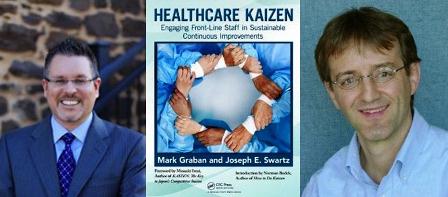
HC Kaizen

The book contains over 200 illustrations; many of them color, all directly related to healthcare. These illustrations are from practical healthcare-related work demonstrated in facilities such as St Francis Health, Akron Children’s Hospital and many others. The content contains examples after examples demonstrating the use of the Kaizen (continuous improvement) concepts all related to healthcare.

I spend much of my time in Sales and Marketing. In these engagements, a certain amount of trust is developed and fortunately my work is sometimes extended into other customer areas, primarily the service area. Of course, healthcare is very service orientated and the examples and illustrations parallel much of my present work. I found many of them very applicable to other service areas.

When we read a well written book, we feel comfortable that we understand the process. They have broken the information down so that it is easily understood. Very similar to good speakers, we walk away saying; “I knew that.” All that is left is for us to do is implement the process. However, most implementations and applications are not so straightforward, and we end up changing very little.

After reading Healthcare Kaizen, I walk away with the feeling that they have explained how to start a Kaizen implementation. I am thinking, “I know this stuff.” However, the book goes a step beyond. It is more than a how to but rather a guide to make our processes better. The book seems like a companion for a Lean journey versus a reference.

If saying that is not enough, what makes this book a keeper is that it may be the best book on Kaizen that I have ever read. Mark and Joe start out explaining Kaizen at the most basic level. So, you do not need to know anything about Lean or Kaizen. They go on to explain how Kaizen is intended to be used, at the place of work utilizing small incremental change, the secret to the success of Kaizen. The book explains a process such as a visual board, gives examples and then provides a how to. It is a step by step guide for the implementation of Kaizen and can be utilized at any level within the organization.

Other thoughts:

  • I reviewed the actual book not the Kindle version. I have no idea, but I cannot imagine a Kindle doing justice to all the illustrations, but someone else has to speak for that.
  • The book is a little expensive for someone to purchase that is not in the healthcare field. But I do compliment the publisher, Productivity Press, for allowing that many colored pictures to be used.
  • There is so much information that you may be overwhelmed. My instincts were to rip the book apart in sections and chunk the knowledge into a more defined space. I am sure that is just a limitation of my learning capacity.
  • The book could be sold by chapter in a Kindle version that would allow it to be utilized for a specific use.
  • I would encourage forming an internal meetup group to discuss each chapter on a monthly basis.
  • I think it would benefit any Healthcare facility.

The book website offers additional information: http://hckaizen.com From the Book Description: Healthcare Kaizen focuses on the principles and methods of daily continuous improvement, or Kaizen, for healthcare professionals and organizations. Kaizen is a Japanese word that means "change for the better," as popularized by Masaaki Imai in his 1986 book Kaizen: The Key To Japan's Competitive Success and through the books of Norman Bodek, both of whom contributed introductory material for this book.

Joseph E. Swartz has been leading continuous improvement efforts for 18 years, including 7 years in healthcare, and has led more than 200 Lean and Six Sigma improvement projects. He is currently the Director of Business Transformation for Franciscan St. Francis Health in Indianapolis, IN.

Mark Graban is the author of Lean Hospitals and has worked as a consultant and coach to healthcare organizations throughout the world. He serves as a faculty member at the Lean Enterprise Institute and is also the Chief Improvement Officer for KaiNexus, a startup software company that helps healthcare organizations manage continuous improvement efforts.

Tuesday, November 27, 2012

Custom Magnetic & Dry Erase Comic Strip

Do you need a customizable comic strip that lets you create your own comics using magnetic characters? It’s a great start for a service design project and creating a customer experience. It’s part of a Kickstarter project by Erik Heumiller. There are loads of options on the website from $1 to $300.

The Magnet Comic is a dry-erase comic strip that uses magnetic characters with a variety of different facial expressions to make the comics you want to make. It also lets you make comics a part of your every day life whether at home or work because it's a physical comic you can display and interact with.

Magnetic board

Kickstarter is a funding platform for creative projects. Everything from films, games, and music to art, design, and technology. Kickstarter is full of ambitious, innovative, and imaginative projects that are brought to life through the direct support of others

Back this Project!

This project will only be funded if at least $6,500 is pledged by Sunday Dec 16, 3:17pm EST.

P.S. Pledge $10 and get a Comic Character of yourself emailed to you.

Monday, November 19, 2012

Difference between Development and Design–Empathy!

The thought process that I try to embed in Lean Service Design can be summed up in one word: Empathy! It is a major differentiator between the traditional process methodologies of Six Sigma, and I say this tongue–in-cheek, Lean. Many times when you review Design for Six Sigma, Lean Startup, Lean Product Development, Lean Services and Lean Design (the list goes on), seldom when you search (like never) the index of the book will you find the words Empathy.

In Lean, you will find the words Respect for People and it is rigorously applied by most Lean practitioners. However, it is typically applied from an internal viewpoint. I do not want to imply that it does not carry over externally (Customer Experience will mimic the Employee Experience) but seldom do I see it addressed. In healthcare, I believe you will see it addressed more than anywhere else at the moment, but I believe that discipline was built from a compassionate side to begin with. It was not guided by Lean as an enabler of empathy. Developing products/services requires an organization to understand the emotional needs and difficulties of their prospects and customers. Our product/service development should be centered on understanding value in use (Service Dominant Logic).

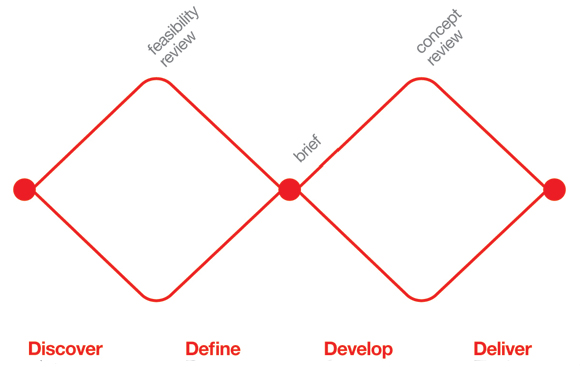
Most organizations struggle in their attempts as they evaluate seas of data often times masqueraded in a method called called voice of customer. Often, it loses the personality of the customer. The tendency is to view development as product/service centric rather than customer/user centric. The area of Empathy is very evident in Service Design and Design Thinking. A few more thoughts about this. The 'Double Diamond' Design Process Model (From the Design Council in the UK – a complete description of the process can be found here.)

Different designers manage the process of design in different ways. But when we studied the design process in eleven leading companies, we found striking similarities and shared approaches among the designers we talked to. In this section we show one way of mapping the design process, and give more detail on the key activities in each of the process's four stages.
The double diamond diagram was developed through in-house research at the Design Council in 2005 as a simple graphical way of describing the design process.
Double Diamond

Divided into four distinct phases, Discover, Define, Develop and Deliver, it maps the divergent and convergent stages of the design process, showing the different modes of thinking that designers use.

What I find intriguing about Design and specifically the double diamond is its similarity with the 4D process of Appreciative Inquiry.
  1. Discovery: What gives life?
  2. Dream: What might be?
  3. Design: What should be?
  4. Destiny: What will be?

Double Diamond for AI

I think the resemblance is not coincidental by any means. I think is a direct reflection on how the Design process has moved development into the customer’s playground. Shaping positive outcomes is only done by understanding (which comes from empathy) the user of your product or service. No longer, can we consider ourselves the experts. We may have more product knowledge but unless we understand how that can be applied and transferred to the use of the product (Service Dominant Logic) it will serve little purpose for the organization and the customer.

Shifting your organization from an internal Product/Service Development process to a Service Design/Design Thinking process may be assisted with a little Appreciative Inquiry training. Empathy is a more difficult process to acquire. Many will say it is a personality trait and much easier to hire than to change someone that has little. A great starting point is a favorite book of mine on the role of empathy in business: Wired to Care: How Companies Prosper When They Create Widespread Empathy.

You may be interested in the Lean Service Design Trilogy Workshop