Business901 Book Specials from other authors on Amazon

Showing posts with label Product Marketing. Show all posts

Monday, September 23, 2013

Mindfulness for Sales?

I have this on and off relationship with Meditation, NLP and Yoga through the years. An extension of this is the practice of visualization. Many of us will consider this for sports and have at one time practiced the technique of visualizing our next golf shot from behind the ball. Of course, we can argue the success of this technique for ourselves, but most professionals do practice the technique.

If it works for sports, why would it not work for sales? Would it be a crazy practice to sit in the car and just visualize the outcome of the sales call? Would it help rehearsing the problems that may be encountered or the people you might see during the call? There is an easier and more beneficial practice that could occur. It is the act of mindfulness or unloading. If we just take a break to rid ourselves of everything going on around us and participate in the presence – would that make us more effective?

When is the last time you did absolutely nothing for 10 whole minutes? Not texting, talking or even thinking? Mindfulness expert Andy Puddicombe describes the transformative power of doing just that: Refreshing your mind for 10 minutes a day, simply by being mindful and experiencing the present moment. (No need for incense or sitting in strange positions.)

Jose Silva is the person that may be best known for bringing meditation to the western culture or at least North America. He also is one of the few that has taken this type of material and applied to the sales arena. His book, Sales Power the Silva Mind Method for Sales Professionals, provides an outline for the process. It is somewhat dated material but I do enjoy the Silva Intuition System. This program has been updated by his daughter Laura Silva and provides an excellent introduction to meditation. If you try it, let me know your results.

Wednesday, September 4, 2013

Framing Big Data, part 1 of 2

If you have two sets of researchers who are telling you contradictory things, and they have their own data sets to support it; how do you tell which one is believable and which one is junk. In Numbersense, what I try to do is to give people, as you say, a framework to start thinking about how you would interpret all these things out there.

…says Kaiser Fung, author of a new book, Numbersense a previous book, Numbers Rule Your World: The Hidden Influence of Probabilities and Statistics on Everything You Do and the popular blog, Junk Charts. Kaiser Fung is a professional statistician with over a decade of experience applying statistical methods to marketing and advertising businesses. He holds an MBA from Harvard Business School, in addition to degrees from Princeton and Cambridge Universities. He is Vice President of Business Intelligence and Analytics at Vimeo, a high-quality video hosting platform for creative people. He previously worked at Sirius XM Radio, American Express, [X+1], Exodus Communications, and Sonus Networks. He is also an adjunct professor at New York University teaching practical statistics.

This is the first of two podcasts with Kaiser. The second one will post next week.

Download Podcast: Click and choose options: Download this episode

or go to the Business901 iTunes Store.

Mobile Version

Android APP

Monday, August 12, 2013

Uncovering Compelling Insights

Steve Portigal. author of Interviewing Users: How to Uncover Compelling Insights, is the founder of  Portigal Consulting. He has interviewed hundreds of people, including families eating breakfast, hotel maintenance staff, architects, rock musicians, home-automation enthusiasts, credit-default swap traders, and radiologists. His work has informed the development of mobile devices, medical information systems, music gear, wine packaging, financial services, corporate intranets, videoconferencing systems, and iPod accessories.

Steve speaks regularly at corporate events and conferences such as CHI, IxDA, Lift, SXSW, UIE, UPA, UX Australia, UX Hong Kong, UX Lisbon, and WebVisions. His articles about culture, design, innovation, and interviewing users have been published in interactions, Core77, Ambidextrous, and Johnny Holland. He blogs at www.portigal.com/blog and tweets at @steveportigal.

Steve was gracious enough to secure a discount code for the book, IUBUSINESS901 for 20% off,  if purchased through Rosenfeld Media, Interviewing Users: How to Uncover Compelling Insights

Download Podcast: Click and choose options: Download this episode

or go to the Business901 iTunes Store.

Mobile Version

Android APP

Saturday, July 27, 2013

An Unexpected path from Unger to Zachi Warfel

UX Designer and author, Russ Unger is next week’s podcast guest. We focused primarily on his new book, Designing the Conversation: Techniques for Successful Facilitation (Voices That Matter). However, I could not resist discussing a favorite book of mine that he wrote several years ago and a 2nd edition was recently published,  A Project Guide to UX Design: For user experience designers in the field or in the making (2nd Edition) (Voices That Matter)

Joe: Well, going back to the book A Project Guide to UX Design. I think you did hit a nice chord there. That book has a lot of granularity. You always get that twenty thousand foot level on projects, but when you start doing a project and follow most books, there are a lot of holes. Your book didn't have a lot of holes, I didn't think?

Russ: Well, thanks. We tried to take the approach of what's a good starting point. Especially, if you are kind of new to this and you're working on a real project in the real world outside of a college scenario where it is kind of safe. What is a great starting point, a good place to start and learn as a foundation and try to give you articles or at least information to help you kind of grow yourself. For example, we provided basic persona and then linked out to Todd Zachi Warfel's personas, which are really, really super detailed. Todd probably does some of the best personas in the business. He was generous in showing us some of his expertise, and that gives people direction to reach out and learn on their own.

Joe: I saw that and there is a real art to building personas?

Russ: You know, there's a lot of art, but I would say there's a heck of a lot more science. When you start to do the research, and you start to collect a lot of data about people's scenarios, various demographics. Those data points really are important. They are a part of what keeps it from being a myth. You start to make it real when you draw in the data from any of the research that you've done.

If you are not familiar with Todd Zachi Warfel’s work, you are missing something. His book Prototyping: A Practitioner's Guide even for a Non-UX person is exceptional. I have incorporated a few of Todd’s ideas along with a mind map at the bottom of this page: Prototypes provide a Pathway for Connecting with Customers

Wednesday, June 5, 2013

Have you ever seen a Comedian use a PowerPoint?

I will admit that I use a PowerPoint more often than not. It is not because I am trying to dazzle anyone, it is mostly for the sake of being my notes for the process. Seldom do I use a tremendous amount of wording on them, but I need a few key prompts to get me through most presentations. I blame this reliance on lack of preparation or procrastination; I am not sure which is more powerful or more to blame.

Recently, I was viewing a few George Carlin presentations on YouTube, and it reminded me, have I ever seen a comedian use a PowerPoint? If you study comedians, you will find them quite professional in their delivery. A list that I created with help from the Wikihow on How to be a Comedian:

  1. Original Material
  2. Ability to read an audience
  3. Relate to the average person
  4. Remember to walk the stage
  5. Respectful attitude
  6. Watch others and emulate one you like
  7. Practice body language and timing
  8. Practice in front of others and notice their reaction
  9. Watch classic presenters like Steve Jobs, Johnny Carson, Jack Welch, Dr. Deming
  10. It’s not a monologue
  11. The single most important, PRACTICE (I might have said it twice) 

George Carlin Talks about “Stuff” (there may be some inappropriate language)

George Carlin's (Farewell George, 1937-2008) classic standup routine about the importance of 'Stuff' in our lives. This was from his appearance at Comic Relief in 1986.

Monday, May 13, 2013

The Planning Cycle

I constructed this document five years ago when most of my consulting centered around project management. As I review it now, I can see where the influences of different planning instruments and schedulers such as Kanban and the Last Planner®  (Last Planner is a registered trademark of Lean Construction Institute has not changed my thinking but enhanced it.


This was never meant as a presentation just a quick 27-page read.  However, it is one of my most downloaded presentations that I have on Slideshare.

Thursday, April 18, 2013

Moving the CODP towards the Customers Point of Use.

Rob van Stekelenborg is the author of Dumontis blog and a recent article Pushing and Pulling in the Supply Chain was one that I enjoyed very much. In the blog, Rob discussed Customer Order Decoupling Point (CODP). A brief excerpt:

The (customer order) decoupling point (CODP) or order penetration point is one of the most well-known logistical concepts. It indicates the inventory location in the value stream up to which the customer order penetrates. The CODP is one of the key design decisions in structuring the value stream and its management. For instance, the CODP separates the part of the value stream that is order- driven (downstream of the CODP), from the part that is forecast-driven (upstream of the CODP). But is that necessarily true? Doesn't Kanban, in fact, represent a good example of managing the upstream part of the value stream based upon consumption rather than forecast? and aren’t a lot of companies still clustering their customer orders downstream of the CODP or working with lot sizes, resulting in products manufactured too early, too late or just too much? This blog post nuances the existing control dogma in relation to the CODP.

I encourage you to read the entire blog post in length, Pushing and Pulling in the Supply Chain.

If you think about the CODP being the fulcrum point of the supply chain or a seesaw, we are always trying to create a balance between supply and demand. However, there is typically some type of buffer stock or a customer willing to wait a certain period which I like to think of as a flat point on top of the fulcrum.  However, this causes another problem. When one side supply or demand, is in excess it tips dramatically in that direction. Our prevention for this is how accurately we forecast. Read what Eli Schragenheim said in a Business901 podcast about forecasting.

Forecasting tries to give me some information. Let us say partial information about the huge question about what will happen tomorrow. How much will I sell tomorrow? How much work will I be able to finish tomorrow? Which means we are not prophets, we do not know what will happen tomorrow, period.

We cannot really predict the future. We can predict some reasonable range of the future, and this is what we need to make any decision. Forecasting is an unbelievably important tool for managers, but again they need to understand what does it mean and what does it contain and how wrong could it be.

I don't know how wrong because they don't like to say how wrong about forecast, which was never intended to give you anything that precise. So what do you mean by wrong? It could tell you whether you can have a narrow, a range or quite a wide range, make up your mind what you are going to do with it. I think it is very valuable information that is really required for daily decision making and I am sorry to say that a vast majority of the people do not understand it.

We had quite a discussion about uncertainty:  Using Theory of Constraints to Handle Uncertainty in Decision Making.

In most markets, it is very difficult to keep a balance and when the safety stock in not replenished in time or the customer demands quickly dwindled, well let’s just say all forecasts are wrong. So, what to do? This is what makes Lean Marketing  for Service Dominant Thinkers (SD-Logic) so powerful. When these principles are applied it makes forecasting further upstream. We are not forecasting from a perspective of our markets rather we are forecasting from a perspective of our customers markets. We have effectively moved our Customer Order Decoupling Point (CODP) to the customers point of use.

Thursday, November 29, 2012

Project and Change Management Simplified eBook

In a recent podcast, Project and Change Management Simplified, Bob Lewis president of IT Catalysts discussed his specialty project and change management.  This is a transcription of the podcast.

Since 1996, when he started his “Survival Guide” column in InfoWorld, Bob has been in the forefront of a guerrilla movement in how businesses should design and plan change, and how the IT function should relate to the rest of the enterprise. Bob is the author of several books to include Bare Bones Project Management: What you can’t not do and Bare Bones Change Management, What you shouldn’t not do.

Bob has recently teamed up with David Anderson (David recently appeared on a Business901 podcast, Change is Best when it Evolves) to present a 2-day workshop on Business Change Management. This will include topics specific to Agile and Lean transition initiatives. More information on the workshop can be found at Business Change Management.. Workshop Date: Los Angeles, CA December 3-4, 2012

My tool for running projects? 

Online Project Management

Monday, November 19, 2012

Difference between Development and Design–Empathy!

The thought process that I try to embed in Lean Service Design can be summed up in one word: Empathy! It is a major differentiator between the traditional process methodologies of Six Sigma, and I say this tongue–in-cheek, Lean. Many times when you review Design for Six Sigma, Lean Startup, Lean Product Development, Lean Services and Lean Design (the list goes on), seldom when you search (like never) the index of the book will you find the words Empathy.

In Lean, you will find the words Respect for People and it is rigorously applied by most Lean practitioners. However, it is typically applied from an internal viewpoint. I do not want to imply that it does not carry over externally (Customer Experience will mimic the Employee Experience) but seldom do I see it addressed. In healthcare, I believe you will see it addressed more than anywhere else at the moment, but I believe that discipline was built from a compassionate side to begin with. It was not guided by Lean as an enabler of empathy. Developing products/services requires an organization to understand the emotional needs and difficulties of their prospects and customers. Our product/service development should be centered on understanding value in use (Service Dominant Logic).

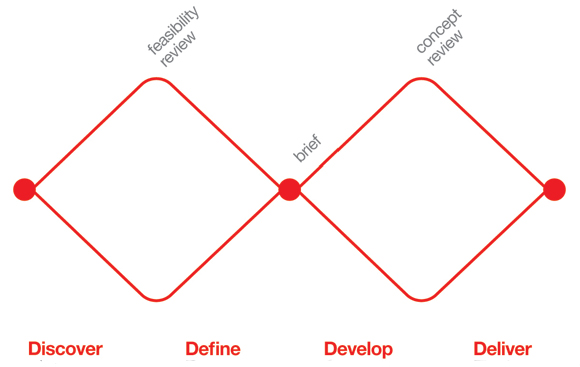
Most organizations struggle in their attempts as they evaluate seas of data often times masqueraded in a method called called voice of customer. Often, it loses the personality of the customer. The tendency is to view development as product/service centric rather than customer/user centric. The area of Empathy is very evident in Service Design and Design Thinking. A few more thoughts about this. The 'Double Diamond' Design Process Model (From the Design Council in the UK – a complete description of the process can be found here.)

Different designers manage the process of design in different ways. But when we studied the design process in eleven leading companies, we found striking similarities and shared approaches among the designers we talked to. In this section we show one way of mapping the design process, and give more detail on the key activities in each of the process's four stages.
The double diamond diagram was developed through in-house research at the Design Council in 2005 as a simple graphical way of describing the design process.
Double Diamond

Divided into four distinct phases, Discover, Define, Develop and Deliver, it maps the divergent and convergent stages of the design process, showing the different modes of thinking that designers use.

What I find intriguing about Design and specifically the double diamond is its similarity with the 4D process of Appreciative Inquiry.
  1. Discovery: What gives life?
  2. Dream: What might be?
  3. Design: What should be?
  4. Destiny: What will be?

Double Diamond for AI

I think the resemblance is not coincidental by any means. I think is a direct reflection on how the Design process has moved development into the customer’s playground. Shaping positive outcomes is only done by understanding (which comes from empathy) the user of your product or service. No longer, can we consider ourselves the experts. We may have more product knowledge but unless we understand how that can be applied and transferred to the use of the product (Service Dominant Logic) it will serve little purpose for the organization and the customer.

Shifting your organization from an internal Product/Service Development process to a Service Design/Design Thinking process may be assisted with a little Appreciative Inquiry training. Empathy is a more difficult process to acquire. Many will say it is a personality trait and much easier to hire than to change someone that has little. A great starting point is a favorite book of mine on the role of empathy in business: Wired to Care: How Companies Prosper When They Create Widespread Empathy.

You may be interested in the Lean Service Design Trilogy Workshop

Thursday, May 31, 2012

Smarter than a Monkey with your Money

A surprising outcome when moneys are giving the same choices as humans. Find out how risk adverse you are…

About: Dr. Laurie Santos, who has been called "the Monkey Whisperer," studies the roots of human irrationality by watching the way our primate relatives make decisions. She'll discuss her recent work on "monkey economics" and will show that some of the silly financial choices seen in humans can be observed in monkeys too. Come hear the intriguing thoughts of the woman recently voted one of Popular Science magazine's "Brilliant 10" Young Minds.

Related Information:
Traditional vs. Emerging Thoughts on Pricing
Find the Right Customer at the Right time
The Death of List Price
How Lucky are you with Pricing?

Tuesday, May 8, 2012

Mastering Positive Change

Sara Lewis, the Managing Director of Appreciating Change, a psychological change consultancy focused on helping leaders and managers achieve positive change in their organizations was my podcast guest. She is the author of Positive Psychology at Work: How Positive Leadership and Appreciative Inquiry Create Inspiring Organizations and one of my favorites, Appreciative Inquiry for Change Management: Using AI to Facilitate Organizational Development .

This is an outstanding addition to the series of Business901 podcasts on Appreciative Inquiry and Positive Change. Sarah works closely with the client to ensure partnership and ownership, we bring expertise in psychology and in social change methodologies such as Appreciative Inquiry, Open Space and World CafĂ©. All of these approaches help reduce resistance to change and the need to create ‘buy-in’, rather people co-create the change of which they will be part. This message resonates throughout the podcast.

Download Podcast: Click and choose options: Download Here  or go to the Business901 iTunes Store.

This year Appreciating Change has begun offering a series of Masterclass workshops to give people the chance to learn directly from Sarah's experience in the field of Positive Psychology and particularly the use of Appreciative Inquiry in the workplace. These run every 3 months and alternate between a Masterclass aimed at fellow practitioners, which is tailored to those who have some experience and understanding of the theory behind organizational change already, and a Masterclass aimed at leaders in organizations which is more aimed at helping them use this learning in their management of the organization.

Related Information:
Getting Resistance to Appreciative Inquiry?
Appreciative Inquiry instead of Problem Solving
An Appreciative Look at the World
My Engagement Strategy – Appreciative Inquiry

Thursday, March 1, 2012

How to Design like an Architect

Doug Patt of How to Architect created this video, How to Design like an Architect which is a great intro to this weeks podcast, Design from an Architects Perspective. I encourage you to visit Doug’s site. It is well constructed and very impressive from both a visual and ease of use perspective.  Doug has a new book coming out and could it be named anything else: How to Architect.

Related Information:
Co-Creation and Open Innovation from HYVEinnovation
An Architects view of Prototyping and Modeling
Your First Prototype is with Pen and Paper
Why Prototype? Customer Interactivity is the Most Meaningful Part of Design

Monday, February 13, 2012

Appreciative Inquiry instead of Problem Solving

Could this be the missing link between Lean and Sales and Marketing? 

Appreciative Inquiry (AI) focuses on growing or increasing in value through exploration and discovery. It is a positive approach to change. It compliments Lean Thinking when you view Lean from a Value perspective versus a Waste Perspective. It is also relevant on how you use Lean. If you use Lean on the supply side of the equation ridding yourself of waste might be the predominant thought. If you use Lean on the demand side, you have a tendency to view it more as a value producing mechanism.

Lean vs Appreciative Inquiry

  • Lean you identify key problems vs AI you look for best experience or practice.
  • Lean analyzes causes vs AI create future vision.
  • Lean finds possible solutions vs AI shares values through dialogue.
  • Lean you create action plans vs AI creates the future.
  • Lean lends itself to linear understanding vs AI "leans" toward circular understanding.

AI-vs-Lean

So what are your thoughts?

  • What happens when you take a positive approach to Lean?
  • Does the same problem solving methods work?
  • Can Appreciative Inquiry co-exist with Lean?

I was introduced to Appreciative Inquiry by fellow blogger, Ankit Patel who can be found at The Lean Way Consulting.

Related Information:
Slideshow, I used for reference:
Value can no longer be defined as What a Customer will pay for!
Evolution of Standard Work in my Sales and Marketing
Prototypes provide a Pathway for Connecting with Customers

Wednesday, February 8, 2012

Mapping the Digital Frontier with the Multiverse

Where is the Digital Frontier taking us? Joe Pine has 2 new books out this summer, Infinite Possibility and The Experience Economy, Updated Edition. The Experience Economy identified a shift in the business world back in 1999 and many of the items discussed are just being realized today. In fact, the idea of staging experiences to leave a memorable and lasting impression is now more relevant than ever. the reason for the 2nd edition. In Infinite Possibility, Joe applies his leading edge thinking to the Digital Frontier. This is a transcription of theBusiness901  podcast with Joe, The Experience Economy Author, Joe Pine discusses Customer Value on the Digital Frontier.

In Infinite Possibility, Pine and Korn provide a new tool The Multiverse™ that helps your organization to search the infinite possibility of value creation that lies on the digital frontier. The Multiverse consists of eight different realms: Reality, Virtuality, Augmented Reality, Alternate Reality, Warped Reality, Augmented Virtuality, Physical Virtuality, and Mirrored Virtuality. You may want to watch this short video on on the Multiverse before reading, Value on the Digital Frontier.

B. Joseph Pine II is an internationally acclaimed author, speaker, and management advisor to Fortune 500 companies and entrepreneurial start-ups alike. He is cofounder of Strategic Horizons LLP, a thinking studio dedicated to helping businesses conceive and design new ways of adding value to their economic offerings. In his speaking and teaching activities, Mr. Pine has addressed both the World Economic Forum and TED, and is a Visiting Scholar with the MIT Design Lab. He has also taught at Penn State, Duke Corporate Education, the University of Minnesota, UCLA’s Anderson Graduate School of Management, and the Harvard Design School. He serves on the editorial boards of Strategy & Leadership and Strategic Direction and is a Senior Fellow with both the Design Futures Council and the European Centre for the Experience Economy, which he co-founded.

Related Information:
What is beyond Customer Experience
The Experience is the Marketing
Progression of Economic Experience -
The Common Thread of Design Thinking, Service Design and Lean Marketing
Continuous Improvement Sales and Marketing Toolset
The Service-dominant Logic of Marketing: Dialog, Debate, And Directions

Thursday, January 26, 2012

Prototypes provide a Pathway for Connecting with Customers

Prototyping is a way to introduce our products or services in a very disarming way. It is a way of saying, “I respect your opinion.” Creating that empathetic connection with others can have a profound impact on your company.

We all prefer to buy products from people that we perceive to be experts in their field. The role of the expert has changed. It is no longer the expert with superior product knowledge; it is the expert that shows knowledge in how the product is used. We have gone from a world of selling benefits and features to a world of listening and collaboration. That connection with a customer clarifies how the product is perceived, not how it may look to us.

Traditional sales approaches in the past center on improving customer experience through techniques that tries to manipulate the customer emotions. In the book Listening With Empathy , author John Selby says,

The new approach is participatory rather than manipulative - teaching you how to shift inwardly from negative to positive moods, and thus become genuinely friendly and helpful. Our Listening with Empathy method will enable you to move through the following four customer-encounter phases with high success:

Phase1 - Preparation: Before meeting with a customer or client, it's vital to put aside any stress, worries, or judgments that may pollute the encounter - and shift your focus toward positive feelings and heart-centered emotions.

Phase 2 - The Moment of Encounter: Right when you meet someone, you need to present an honest, friendly, nonjudgmental greeting, and offer relaxed space. New techniques can help you maintain a bright inner center, emit a friendly presence, and converse with relaxed spontaneity, acceptance, and enjoyment.

Phase 3 - Empathic Communication: When you begin talking business, you need to maintain clear intent to be of service and to enable your customers to truly satisfy their needs. By encouraging an enjoyable emotion atmosphere, you can make sure your customers feel good hands and well taken care of.

Phase 4 - Processing: This fourth phase involves pausing after a meeting to reflect on a recent sales or service encounter and to decide purposefully how to follow up on it. You'll learn to re-experience positive aspects of the encounter and focus on your desire to meet with the customer again.

Prototyping can be a powerful tool but only if you are willing listen and make that connection with your customers. The ability to reach outside of companies and connect with our customers develop a shared outlook of our markets and will allow us to develop new opportunities faster than their competitors. It is a simple fact that the companies that know their customers best are the market leaders. They understand what is important. The companies that don’t, market to the general public and as a result get average results. Our new products, our prototypes are shared experiences. Prototypes should serve as models not just for improved design but for improved connection with our customers.

P.S. The easiest form of engagement is listening. Well, maybe not the easiest.

Related Information:
Your First Prototype is with Pen and Paper
Why Prototype? Customer Interactivity is the Most Meaningful Part of Design
Lean Thinking: Prototype early and often
Will the Mvp crush the Lean Startup?

Wednesday, January 25, 2012

A Product Marketers perspective on Prototyping

Matthew Yubas is the author of Getting Your Prototype Made Quick and Easy and a Marketing Consultant for the Small Business Development and International Trade Center. He has developed products for 24 years as an Engineer, Product Manager, and Consultant for startups, small business, and Fortune 500 companies. As an young entrepreneur, he was a co-founder of a software company that developed one of the first personal information management software products. Matt Yubas

Matt has launched new products such as software applications, wireless devices, and websites. In addition, he has helped clients in a diverse number of industries that include photography equipment, auto accessories, soy candles, children's clothing, sporting goods, digital art, and home décor. Matthew is the author of several articles, eBooks, kits, and the popular book Product Idea to Product Success: A Complete Step-by-Step Guide to Making Money from Your Idea .


Download Podcast: Click and choose options: Prototype or go to the Business901 iTunes Store.

Matt’s mission is to help inventors, entrepreneurs, and everyday people with ideas. He Says, “You might have an invention that can benefit society and make our lives easier. No one can do it alone. If you haven't taken a product to the market before, you need a coach to help you get over the hurdles and past the many pitfalls. Be persistent, be smart, and gather the right information before you make your next move”. Mark can be found at http://productcoach.com.

Related Information:
Prototyping into a Working Form
Prototypes provide a Pathway for Connecting with Customers
Your First Prototype is with Pen and Paper
Why Prototype? Customer Interactivity is the Most Meaningful Part of Design

Tuesday, January 24, 2012

Prototyping into a Working Form

An original idea may be your starting point and Your First Prototype is with Pen and Paper. If or when your idea receives support from others, you will be at a point to take more serious design steps. Most successful product launches start with a clear vision of what they want to accomplish. This is not saying that you will not change or even “Pivot” later on but without that clear vision initially it is very difficult to generate a lot of steam that is required to drive to a successful conclusion.

In the book Innovation Acceleration: Transforming Organizational Thinking, the authors use the term “project pillars” as a way of clarifying your vision. Their example was the "project pillars" for the Palm Pilot.

    • Fits in pocket.
    • Synchronizes seamlessly with PC
    • Fast and easy to use
    • Costs no more than $299
    • The authors go on to say:

The company was able to build the world's first successful personal digital assistant. Meeting those constraints required a lot of trial and error, but it provided targets to focus the team’s creative energies. Once you have nailed the general design concept, this approach leads to more innovative outcomes rather than meandering aimlessly from one idea to another. This is a tricky position because you have to balance direct with an open mind. palm pilot

They outline a design thinking process in the book that I believe can be utilized in designing your prototype. I paraphrase their material and combined with my own into a format for prototypes:

Keep good records – Archive everything. I use to use a box in my room for different design projects. I would tear out magazine articles, copies of book pages, pictures, sketches. I have since narrowed that down and store most of my files electronically that also includes audio and video recordings, links to other material and so forth.

Constantly generate and refine ideas based on customer’s perspective – This is not problem solving. It is one of the reasons that I discuss the Marketing Gateway of EDCA > PDCA>SDCA. It is also why getting a prototype out in front of customer early – even in the pen and paper stage is so important. What we think are great ideas, may not be so great. If you are going to be radical as Clayton Christensen says, “Consider your customers’ deepest values and interest rather than their purchasing behavior”.

Visualization, Mock-ups, Models - This is the most effective way of advancing an idea into reality. This is the heart of your prototype. Remember that verbal communication is often misunderstood. A better way to communicate your idea is to express it in some type of visual form. It can be done through sketches, mechanical drawings, or 3-D computer programs. As the old saying goes, a picture is worth a thousand words. If a picture is worth a thousand words, an actual physical representation is worth a million words. If you want to get great feedback on your idea, build a prototype. Nothing gets your idea across better than something people can view from different angles and provide questions and feedback. One of the reasons managers struggle with this guideline is that they fear a lot of craftsmanship and expertise is required to build a prototype, but this is not necessarily true. Prototypes can be inexpensive and basic.

When you see a prototype being used, or played with you'll know you're on the right path. One of my favorite stories and coincidentally again about the Palm Pilot was that the inventor went into a “Shark Tank” (not the TV show or a literal definition) and was completely ill-prepared. Looking around for something to engage his audience, he tossed a wallet in the middle of the table and said it would look something like this. Moments later, he saw them starting to look at the wallet and knew the deal was done when they started passing the wallet around the table.

Consciously Select Solution Paths – You will face issues as you proceed. This is the point where discipline is important. People may give up because the problems seem too overwhelming to solve. In Mark Graban‘s Book Review: One Small Step Can Change Your Life: The Kaizen Way on his blog, he states:

Maurer also has tips and lessons about rewiring one’s brain for kaizen and changes, including leading yourself and others by asking small questions, such as “What’s the smallest step I can take to be more efficient?”, learning to practice this habit in a kaizen style by starting small…

Mauer also makes a great case for how we start, with kaizen, by learning how to see and address little problems. Then, we are able to see and fix larger problems.

This is why prototyping early is so important. It allows for minor changes early in the process and the ability to undo changes that later may prove to be ineffective. If you can overcome these challenges, it will give you a competitive advantage over other companies, because you will have gained particular knowledge and a distinct product for the market.

Your solution path is very much like an airplane ride. You are continuously off course, constantly adjusting and finally arriving at your destination.

Get Feedback and Involvement from a variety of People - Search for feedback from a diverse group of potential customers, suppliers, fellow managers, employees, and content experts. You may get a lot of suggestions, but only a few might be useful (that's okay; it is a journey). You never know when someone will give you an unexpected insight that would have been overlooked had you not searched out a lot of the opinion of others. The key point is to build something you can receive feedback on and return to rebuild as soon as possible. Moreover, with available technologies today, it's getting easier to make prototypes. But don’t stop there. What about an interactive play? What would a sales presentation look like as a prototype? You could invite customers and maybe even local actors and directors of local theaters. This is play time, use it and get the most out of it from as many people as possible.

Prototyping is meant to be an iterative process. But this is a new practice for most people and organizations. Most people within organizations are implementing orders and maintaining the way a company operates. So how do create this type of thinking and bring it into reality in everyday work? More importantly, how do you learn to experiment?

P.S. Want to get an idea across, or a problem solved in an internal setting. Remember the old game of telephone. – give them a prototype and see what develops.

Related Information:
Prototypes provide a Pathway for Connecting with Customers
Your First Prototype is with Pen and Paper
Why Prototype? Customer Interactivity is the Most Meaningful Part of Design

Wednesday, January 11, 2012

Why Prototype? Customer Interactivity is the Most Meaningful Part of Design

Prototypes are becoming a design deliverable with the advent of many sophisticated software applications spurred by Rapid Prototyping, 3D Modeling etc. However, the initial paper sketch is arguably the best tool, at least in the beginning. Prototyping helps us to design better user experiences. However, many of us still forget to include the user! We still dwell on what we can do versus looking at what the user does! Even at the paper stage of prototyping, I encourage you to try to articulate that feeling and function of the design into a model and put it in the hands of the user. Their interactivity is the most meaningful part of design. Do it early and do it often.

From adaptive path blog, Rapid Prototyping Tools:

Making Effective Prototypes

In order to evaluate a prototyping tool or technique, we first need to define what makes an effective prototype. The best prototypes are ones that slipstream right into our design process. We want the ability to quickly take sketches from a whiteboard to something interactive.

Effective prototypes are fast. We want to use techniques that allow for rapid iteration. A prototype should not just be bolted onto the end of a design process. Incorporating the creation of a prototype into your daily design work allows new ideas to emerge and validates concepts quickly.

Effective prototypes are disposable. Just like with any design deliverable, we are creating an artifact intended to express an idea to someone else (stakeholder, developer, user, etc). Once that design idea has been communicated, the prototype deliverable can be discarded. We don’t have to feel the burden of creating a masterpiece that will live on, and we certainly don’t have to work in production-level code.

Effective prototypes are focused. We want to select the interactions of our design that really need to be prototyped. Look for the parts of your design that have of complexity. Look for interaction patterns repeated throughout the user’s experience. Look for the interactions that bring revenue to your product. A prototype that demonstrates these interactions will be the best use of your time and energy.

An informative presentations on prototyping is from Jonathan Arnowitz who happens to be one of the authors of Effective Prototyping with Excel. In the book, the authors discuss how to use use Excel skills to create prototypes especially for wire frames. It is interesting how such a common and widely owned tool can offer such a wide array of solutions. The presentation below labors on wireframes at the beginning but the message soon turns into applicable information for all.

Related Information:
The Death of PDCA
Spontaneous Marks help you think – Doodling
Brilliant – Learn by Doing
Lean Thinking: Prototype early and often

Wednesday, October 26, 2011

Is there a compatible future for Lean and MRP?

There seems to be an element of distaste from Lean Supply Chain people about MRP. Not being a Supply Chain expert it is really not for me to comment. But I did ask Carol Ptak and Chad Smith to address a few of those issues in the Business901 podcast, and in the podcast, Is Orlicky’s MRP relevant today? Think DDMRP. Below is an excerpt from the podcast on one of those questions:

First of all, we owe Lean a huge debt of gratitude to getting some critical elements in front of industry. One thing that I think is very important is the Lean crowd, I think, unfairly gets branded as anti‑technology. I think that that's unfair because, up until now, technology hasn't worked for Lean very well. If you look at the basic rules of MRP and how it works, it doesn't work well for Lean. If you look at the Toyota Production System, even the critical points in the Toyota Production System about technology, I think, Liker's book, I think it's point eight.

It says, "Use only thoroughly tested and proven technological methods for your people and processes." Well, up until now, there haven't been thoroughly tested or proven technological processes.

So it's forced the Lean community, it's forced the TOC community back into manual systems. And those manual systems are breaking down. They're too intensive. And for larger corporations, you really lose a lot of visibility across an enterprise. In fact, for larger companies, Joe, the idea of enterprise Lean really doesn't exist. And why? It's because we have limitations with technology.

Now, what Carol and I are doing here is we're saying, look. Let's not throw the baby out with the bath water. Let's not just throw out the promise of technology and jump all the way back to manual re‑order point systems. Let's figure out how we have to change the formal planning logic to create new rules that then foster new tools that both the formal planning crowd and the Lean crowd can embrace.

And so far, we've heard really good feedback from both sides of the fence here that says, "Yeah, this seems to solve the things that we need to see" and from the Lean side, it also seems to be right in line and actually even facilitate their objectives.

Below is a transcription of the entire conversation:


Introduction to Demand Driven MRP -


Carol Ptak and Chad Smith were asked to co-author the new Orlicky’s Material Requirements Planning 3/E. Carol and Chad were on previous podcasts with me, In a Supply Chain, Where is more important than How Much! and Can MRP be a Demand – Driven Tool?. They can be found at the Demand Driven Institute.

This past week I had a good time applying a few of the DDMRP concepts to sales and marketing. Exercises like this helps me stretch my thoughts a little.

Related Information:

  1. What Sales and Marketing can learn from Demand Driven Manufacturing
  2. Positioning your organization to learn from your customers
  3. Profiling the customer by knowledge gaps
  4. Dynamic Buffer: Think Self-organized Teams
  5. Systemizing the transfer of knowledge at the execution level
  6. Highly Visible and Collaborative Execution
  7. Summary of the 6-part blog Series using DDMRP

Wednesday, October 19, 2011

Political Campaigning – Strategy Update

In a recent Blog post What political campaigns can teach business, I discussed how using a similar strategy could be one of the most productive methods of creating immediate business. One of the most important processes of getting anything done is always clarity and keeping your organization updated. Turning strategy into tactics into action requires empowerment armed with that clarity. Look how David Plouffe’s campaign manager of President Obama’s 2008 presents a slideshow on the state of the race and the resources needed to win battleground states.

Plouffe’s does an outstanding job of a strategic overview, mapping the process, breaking it down to its simplest structure. His appeal to the emotional side is excellent and a lesson in motivating your constituents to get out the vote and raise more money.

How do your managers address your virtual audience? Would this work to motivate a sales force? Your distributor network? Your referral network?

Related Information:
Is your marketing firm having this conversation with you?
The New Names of Marketing are still PDCA
Will Product Managers embrace Open Innovation?
What political campaigns can teach business
Lean Six Sigma for Government