Sunday, October 1, 2017


Friday, July 3, 2015
5 Core Sales Concepts of Lean Thinking
When introducing Lean Thinking many of us would start with the five core concepts of Lean depicted in the classic books, The Machine that Changed the World and Lean Thinking by Womack and Jones.
The basic thought process goes something like this: As value is
specified, value streams are identified, wasted steps are removed, and
flow and pull are introduced. And we begin the process again and
continue it until a state of perfection is reached in which perfect
value is created with no waste.
5 Core Concepts of Lean Thinking:
- Identify Value
- Map Value Stream
- Create Flow
- Establish Pull
- Seek Perfection
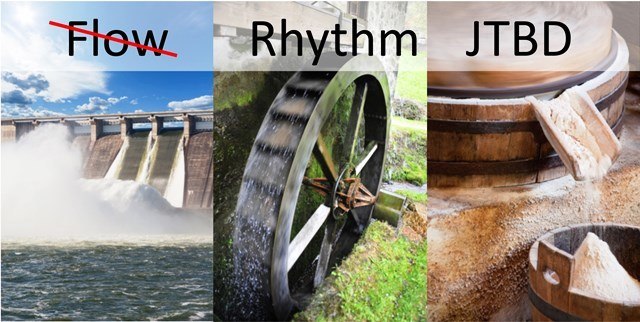
5 Sales Concepts of Lean Thinking
- Identify Value = Job To Be Done
- Map Value Stream = Customer Journey thru Use
- Create Flow = Rhythm
- Establish Pull = Adaptive, Agility
- Seek Perfection = Continuous Learning
Many wonder how to put this in practice and for a template I use the five phases of Agile Project Management by Jim Highsmith. I adapted his description to a marketing tone.
Envision. Speculate. Explore. Adapt. Close.
- Envision: Determine your marketing vision and objectives and constraints, your community, and how your team will work together.
- Speculate: develop the capability and/or feature based launch to deliver on the vision.
- Explore: plan and deliver running tested stories in the short iteration, constantly seeking to reduce risk and uncertainty.
- Adapt: review the delivered results, the current situation, and the team’s performance, and adapt as necessary.
- Close: conclude the launch, pass along key learning, and celebrate.
Friday, November 8, 2013
No Steve, Jack or Bill, just The Caterpillar Way
How many companies get Leadership right? Do you always have to have that charismatic leader that makes us think about them before the company? Tomorrow’s podcast is with Craig Bouchard, author of the book, The Caterpillar Way: Lessons in Leadership, Growth, and Shareholder Value. If you know my legacy a bit, you understand the high degree of interest.
An excerpt from the podcast:
Joe: What struck me about the book more than anything else is that there was not a Jack Welch, a Steve Jobs, or a Bill Gates. It was a credit to the entire Cat organization. Was that true? Is that how Cat is?
Craig Bouchard: I really confess. It's incredibly true. I've been the CEO for a couple of companies. I'm the CEO of Signature Group, a public company right now, in a great company. But in the case of Caterpillar, I've never seen such a large group of people so thoroughly dedicated in increasing their revenues and decreasing their expenses as a team - which is kind of simple - but what I'm trying to say is that it's rare in real experience. That company is really - everybody is on the same page and that's a management feat of course that they've accomplished that.
Joe: Yes it's a huge management feat but not to have that person out there waving the flag just amazes me.
Craig: Yes and when I look at Cat is and the most remarkable thing going back to the 80's. They had basically six incredibly large complicated decisions to change the company during this past thirty years. Six times, they turned the entire place upside-down strategically requiring such a flexibility of their management and their workforce - it's just really remarkable and each one of those decisions could have turned into a disaster and each one like them have turned into disaster for other companies, and Caterpillar went six-for-six. Basically with four different Chief Executive Officers through that time period responsible for those six decisions. Not only did they go six-for-six in decisions, they managed to get it right who was the right person to implement and come up with an implementation for each of them. This kind of a record is almost unheard of in terms of these types of gigantic decisions were implemented.
Joe: Did the CEOs get picked based on the needed initiative, or because they were good at, or did it happen because they were at that?
Craig: We talked about that a little bit in the book. How much of it is luck and how much of it is that the board of directors, they had at the time, picked the right guy for the right job in the challenges that existed at that time. Between Donald Fites, Glen Barton, James Owen, Doug Oberhelman and George Schaefer before, these five guys are very different people with different skill sets. In whatever way that it was accomplished with the board of directors at Caterpillar and its succession planning is a very determined and thorough process in the company. To put in place the right person at the right time in those challenges during those thirty years and my conclusion because they got it right five times in a row - it is not luck.
About Craig Brouchard ( http://www.craigbouchard.com): Entrepreneur, writer, art collector, great father and pretty good husband. Crafted the first and only "hostile reverse tender merger" ever successfully completed on Wall St and founded two public companies; Esmark and Shale-Inland.
- 2013 - Founded Cambelle-Inland, named for my daughter Cambelle
- 2010 - Founded Shale-Inland, named for my daughter Shale, now public in the bond markets (A3)
- 2003 - Founded Esmark Inc., the highest appreciating stock on Nasdaq for the full year 2008
Saturday, November 2, 2013
Improving Interactions through the Lean Value Chain
Making products fly involves more than just the development team. So how do we involve, interact and improve with the non software parts of the value chain? Let Mattias Skarin walk through lean techniques and thinking that helps drive improvements across organizational borders. Mattius is one of thought leaders of the Kanban Movement and is speaking at the upcoming Lean Kanban Central Europe Conference (It is in Hamburg, Germany, Nov 4-5, 2013). He is speaking about: Improving the full value chain & Visualization – What‘s my brain got to do with it? (Lightning Talk)
Mattias Skarin works as a Lean and Kanban coach, building systems that enables you to cut time to market and improve quality. He has helped several software teams deliver with confidence, scaled Scrum over multiple teams (cutting game cycle time from 24 months to 4) and improved life at operations using Kanban. He is an author of the book, Kanban and Scrum – making the most of both, and regularly train and coach in Lean, Kanban and TDD. He blogs on http://blog.crisp.se/mattiasskarin and the blog has one of the best set of sample Kanban boards on the planet.
Lean Sales and Marketing: Learn about using CAP-Do
Thursday, October 31, 2013
Our Decisions Need to be Co-created
When we approach sales we typically think of how we will address the customer’s problem. What needs we need to address and how we will do this in an engaging way? We are in The Experience Economy says authors Pine and Gilmore. Though many of us dwell on the Experience Economy, I think we are moving past that at an accelerated rate. This movement has its foundation in Service Dominant Logic, where the fundamental belief is that value is co-created with customers. The value is in the use of the product or service. This type of thinking is awkward to many organizations. In my latest book CAP-Do: Connecting Demand to the Lean Supply Chain, I begin the journey discussing sales and marketing from a perspective of being systemic, emergent, and participatory.
My latest thinking has been a result of spending time with stakeholder and customer journey maps and building user personas. These processes have assisted me moving from inside-out thinking to an outside –in perspective. It also helped my clients build better customer experiences. What I realized working with customers was that many of common problems they encountered became rather standard to deal with and many even automated. When we addressed sales issues we found a striking number as either straight-forward or responding to “opportunities” we had little chance of winning. If you would like more information on my sales perspective, read the blog post, Lean Salespeople are Challengers, not Problem Solvers.
The world of sales is on the edge of a collaborative way of selling. We no longer can just sell to a customer; we have to understand our customers’ business and our customers’ customer’s business. This can be done through scenario planning and from a perspective of being systemic, emergent, and participatory or The Cap-Do process.
From the book ' target=_blank>' target=_blank>' target=_blank>' target=_blank>Solving Tough Problems, author Adam Kahane classifies problems. His definitions:
- A problem has low dynamic complexity if cause and effect are close together in space and time.
- A problem has high dynamic complexity if cause and effect are far apart in space and time.
- A problem has low generative complexity if its future is familiar and predictable.
- A problem has high generative complexity if its future is unfamiliar and unpredictable.
- A problem has low social complexity if the people who are part of the problem have common assumptions, values, rationales, and objectives.
- A problem has high social complexity if the people involved look at things differently.
When any of the problems exist that are coded in red, they are fairly simple problems to address and most organizations know the answers and their preferred vendors. They may make a decision with preferred vendors or research other vendors just to confirm their decision (The dreaded request for proposal we often receive).
The other set of problems, not in red, we struggle with as organizations. They are often described as messy or wicked problems. The latest inbound marketing programs that are “social” in nature fail to deliver. They are simply built from our old thinking of a marketing funnel, responders, and workflows. We guide and manipulate the customer down some arbitrary path to arrive at the correct (our) decision.
As Kahane says,
Simple problems, with low complexity, can be solved perfectly well—efficiency and effectively—using processes that are piecemeal, backward looking, and authoritarian. By contrast, highly complex problems can only be solved using processes that are systemic, emergent, and participatory.
We as an organization do not have solutions to problems of high generative complexity. They cannot be calculated in advance, in a journey map, based on our past thinking, but have to be worked out as the situation unfolds. Seldom are they miraculously worked out by “single experts” but rather by a team of highly involved people. A coalition or a team made up of customer(s) and vendor(s) must accept the fact that there is not one right answer. It must emerge from doing or working towards the problem. Just as value is co-created in use our decisions need to be co-created.
We always equated the experience economy to a theater with actors being the customer facing people, the back stage the supporting cast and the audience the customer. I think that is a broken metaphor. A better metaphor may be a race team where the product/service is the car, and the driver (customer) is using it. The pit crew (vendor) is in constant communication and in support of its use. There is no backstage, we are completely transparent and, in fact, the customer’s own support might be part of the pit crew.
Do you have an analogy that might work?
Thursday, October 24, 2013
Stop Looking for Mister Right
They simply don’t exist. I see people building Persona after Persona targeting that Ideal Customer. The problem that exists is that ideal customers are few and far between. In a recent blog post, A Persona Board deserves a Place at the Table, I described creating User Personas from your existing customers and then grouping them into quadrants based on product/market fit or relationships. The purpose of this is not so much to learn about customers as it is to learn about yourself and your core capabilities.
A fun exercise once you have created customer (user) personas, you can segment them according to how they fit in the quadrants mentioned in the above post. Then start asking these questions and others you may think of..
Relationship Customers:
- Which customers buy from you because they dislike the relationship they have with your competitor?
- Which customers buy from you because they like the relationship they have with you?
Product/Service (I will only use Product going forward) Customers:
- Which customers buy from you because you have a better value proposition (price/function) than your competitor?
Relationship Prospects:
- Which prospects buy from your competitor because they like the relationship they have with your competitor?
- Which prospects buy from your competitor because they dislike the relationship they have with you?
Product Prospects:
- Which prospects buy from your competitor because your competitor has a better value proposition (price/function) than you?
Marketing is in the business of creating customers. If we want to create a customer, we must take a divergent view versus a convergent view. Most marketing schemes, funnels and all that stuff are great at telling you how to manipulate a customer through the process to create a buyer, but few of them tell you how to create targeted prospects. A simple process is to use existing Customer Personas and create Prospect/Competitor Personas based on Relationship or Product groups.
When we look at the existing differences, we start identifying key points that we can address to gain access to others. In the Lean world, we call these opportunities gaps. We identify these gaps, and create different scenarios on how to close the existing gaps. We seek to understand why prospects may or may not move towards a target.
When viewing this from a structural tension metaphor, we will notice resistance as we try to coerce the customer towards the new target or condition. See my blog post, A New Approach to Lean with Robert Fritz.. We will oscillate between these two positions unless we can find common agreement of purpose. I like using the Theory of Constraints Evaporating Cloud (How to See the Other Side of a Conversation) as the way to resolve the difference. If we can find an overall purpose that will become a shared understanding – it resolves the conflict, it creates an opportunity for us to give an opportunity for prospects to move from one particular state to a different (closer to our thinking) state. It is the shared understanding that must exist to create the change in state.
SD-Logic way to Partnerships
When I first started in consulting, I spent a lot of time going to network meetings in town. It was the thing to do at the time. What I came to realize is that everyone had a product/service for my customer. Few of my services fit their companies. So, what happened is that I had two choices. One, spend a lot of time selling someone else’s product/service with little return for myself. Two, stop going to network meetings and go find a customer.
This is not meant as a slam on the other networkers. It is even common in the business world. We always see opportunities in how we can partner with others. Mostly on how they need our product/service. They are weak in the area we excel in. The reason most of the time it is not that they are weak or lack expertise; it is more about the energy they are willing to spend on that portion of their business. First, they have not found it profitable or second, they have not found enough demand for developing it.
We view other product/services as not competitive products, but complementary products. I always think that is BS - We are competing for not only the same wallet, but more importantly the time or resources to implement the process. Whoever has the greatest burning platform,and the easiest to implement is usually the winner. If you are depending on your new partners, to sell it for you, you may be mistaken. The time and energy will be spent on their product/service. In this case, few of your products/services are sold and market is a t best minimal or about the same amount you could have created yourself.
If we cannot lead our new partners into acquiring more customers (not retention and up-selling) with fewer headaches; we may not be a good match. I believe the power has to come from acquiring new market-share based on the new synergies. If it only about add-on sells, the efforts are typically very minimal. And with that said, I have not even discussed pricing strategies and how they have to fit in.
Many will say that I may have too many negative thoughts about this. However, I think on a larger scale it is why so many acquisitions struggle for success. Matches are difficult for small companies and large companies. I have found that the correct fit evolves more so than is created. We need the market to drive the synergy not try to create it. Look for partners that you find yourself having a coffee together at a customers. Find them in places where your product/service is being used. In this manner, the customer or market has created the synergy. I liken this to using Service Dominant Logic thinking. Your thoughts?
Wednesday, October 23, 2013
Boundaries of Kanban
Markus Andrezak is speaking at the upcoming Lean Kanban Central Europe Conference (It is Hamburg, Germany, Nov 4-5, 2013) about Boundaries of Kanban - Disruptive Innovation. An overview of Markus’s talk sums up our conversation in the podcast quite well.
Lean Kanban Central Europe Conference: Kanban is fantastic in the support the flow of product development and self improvement of teams in that area. However, at each time the process defined through Kanban poses an impediment to work in the creative field. While Kanban may very well fit to work in the domains of product maintenance and iterative, feature by feature innovation, it does not support evolutionary or disruptive innovation. These types of innovation dip slightly or even more into chaos and are completely non linear processes which simply do not fit the Kanban board and process. The talk will show how to protect innovation from delivery and how to create the necessary level of communication between these areas w/o creating silos.
An excerpt from the podcast:
Joe: I've struggled when I’ve applied Kanban to sales and marketing because it is similar thinking, it is very non-linear. The way I view it is that it's not this linear progression as much as it’s an iterative circle within a certain column. That group could be always there until they come out of the loop somewhere. They could either go backwards or forward. Is that similar type thinking to what you have done or do you have a better way?
Markus: I think it's very interesting what you said because I had this discussion last week with the great guys of TLC Lab in New York, Jabe and Simon Marcus. They came up with the similar idea because they tried to use Kanban in the way that you described it.
What I said to them is that you can put that work on the Kanban board and put a container around it and just ignore that it’s on the Kanban board. What will still happen is that people will look at the container that’s protecting this design work from the production constraints so to speak and somehow feel like it has been a stranger on the board. Now you could have a very great company culture and everybody will tolerate that stuff on the Kanban board. On the other hand, if it's on the Kanban board the Kanban system should be helpful of this work otherwise you would not put it on the Kanban board.
Again, this process is completely non-linear and going on and on as you say, my question would be of what help word Kanban be for the designers and I think of no help. If you look at what's going on in the gaming industry, how they’re coming up with new ideas for the games is in very small prototyping teams which are not working in any method. Maybe Design Thinking or maybe Design Studios, but they’re not working on any development-like or production-like methodologies. Rather what they do is something which Toyota might call set base design, so highly parallel work in very small teams to come up with lots of new ideas for a similar problem. I think this is good but you can't organize it on a Kanban, at least not that it would help so you could do Kanban but I think it would be of no help for anybody.
About Markus: Markus Andrezak has been active in different contexts as Product and Development Manager for high traffic and high revenue web sites. During the last years his main focus has been transitions towards Lean and Kanban product management and development practices across his portfolio. With Arne Roock, he also co-authored 'Replenishment', a free eBook on Kanban. His Blog: Portagile and Twitter: @markusandrezak. You can find more information at his company website: http://ueberproduct.de/en/.
Tuesday, October 22, 2013
Lean Service Design Slidedeck
At the ASQ 2013 Service Conference, this week, I had the honor of giving a sixty-minute presentation on Lean Service Design. All the participants of my presentation received a CD that contained my Lean Service Design Program. This is the slidedeck from the presentation.
I also introduced CAP-Do (More Info) to the audience. CAP-Do is a systematic way to address the problems (pain) or opportunities (gain) from the use of our products and services.
Purchase the Lean Service Design Program!
Or, purchase the 130 page PDF for download, Lean Service Design
Sunday, October 13, 2013
Kanban Thinking with Andrezak
@markusandrezak aka Markus Andrezak has been active in different contexts as Product and Development Manager for high traffic and high revenue web sites. During the last years his main focus has been transitions towards Lean and Kanban product management and development practices across his portfolio. With Arne Roock, he co-authored ‘Replenishment’, a free eBook on Kanban. His Blog: Portagile and Twitter: @markusandrezak. You can find more information at his company website: http://ueberproduct.de/en/.
Markus is one of thought leaders of the Kanban Movement and is speaking at the upcoming Lean Kanban Central Europe Conference (It is in Hamburg, Germany, Nov 4-5, 2013) about Boundaries of Kanban – Disruptive Innovation.
A written excerpt from our conversation was posted last week, Boundaries of Kanban in Sales and Marketing.
Lean Sales and Marketing: Learn about using CAP-Do
Saturday, October 5, 2013
The Starbucks Way of Connecting with Customers
It is a lesson in strategic marketing that few books meant for that purpose can even come close. After reading, most of Joseph Michelli’s books, and doing a podcast with him several years ago, I concluded after reading Joe’s latest book, Leading the Starbucks Way: 5 Principles for Connecting with Your Customers, Your Products and Your People, that it is his best work to date.
From the forward of the book:
Each of Dr. Joseph Michelli's books offers a learning laboratory that's rich with examples from leaders as they address the aforementioned challenges and opportunities. They provide information, insights, and analysis on how leaders seek to create a high-performance organization that operates through the lens of humanity. This book demonstrates both the setbacks and the breakthroughs that the Starbucks leadership has encountered as it has attempted to position its products and people to deliver consistent, engaging, and loyalty-enhancing experiences.
Herve Humler
President and Chief Operations Officer
The Ritz-Carlton Hotel Company, L.L.C.
I have another compliment for Joe. There may not be a better interviewee that can make an interviewer feel that good about himself. At times, I had to remind myself who the “star” was. – My hat goes off to Dr. Joseph Michelli.
P.S. When you find out Joe’s next book subject, you will be anticipating the arrival for the next two years.
Download Podcast: Click and choose options: Download this episode
or go to the Business901 iTunes Store.
Lean Sales and Marketing: Learn about using CAP-Do
Tuesday, October 1, 2013
Using Scenarios for Current Applications
This video does an excellent job of explaining Scenario Planning. The most common application of is for futuristic thinking and considering the different scenarios that may play out. In the video, it will comment on how this method is used in lieu of forecasting or maybe even when Predictive analytics, no longer work (Podcast, The Power to Predict Who will...).
When you view this video take a different approach. Instead of looking at the limiting perspective of Scenario Planning for the future view it from a perspective of building Customer Scenarios along the Customer Journey. Instead of assuming a customer was going to react a certain way, we match them to the Scenarios that may happen as a result of being in this position.
If we view the Customer’s Journey as a Scenario Journey does that cause a different reaction? Would that help us to seek to understand first?
Monday, September 30, 2013
Lean Service Design Presentation at ASQ
I have the pleasure of participating in the conference and will be giving a sixty-minute presentation on Lean Service Design. My presentation will be building offering a unique perspective on applying Lean to the Service Design Field. All participants of my presentation will receive a CD that contains:
- 130 Page PDF eBook
- PDF & Excel work forms
- Training Videos
- Bonus eBooks and Audio Tracks
My discussion will begin with a discussion on Service Dominant Logic and go through the use of Stakeholder and Customer Journey Maps and Buyer Personas. We will use these 3 outlines to develop several service prototypes narrowing it done to a single choice. The Lean Process of moving from EDCA to PDCA to SDCA will be discussed in conjunction with the before mentioned processes. The last part of the hour I will introduce CAP-Do and the use (sorry for the pun) of User Personas and Scenarios creating a process that I call Persona Mapping.

This ASQ 2013 Service Conference provides how-to’s, step-by-step advice, and the latest in service delivery methods and networking opportunities. Speakers will engage you on topics to help organizations improve customer service, reduce costs, and build both customer loyalty and satisfaction. Join us in Las Vegas for two days of networking and discovery.

22nd Annual Service Quality Conference
October 7–8, 2013 • Las Vegas, NV
THEME: Seizing the Competitive Advantage with Service Quality
REGISTER: Program details are now listed on the site. To or get more information, visit asq.org/sqd or call 800-248-1946. If you are from outside of the United States of Canada, please call +1-414-272-8575.
Thursday, September 26, 2013
A Simple but Effective Communication Model
The Process Communication Model (PCM) was developed by Dr. Taibi Kahler and Judy and Joe Pauley have been teaching and implementing this model for over twenty years. I enjoy the simplicity of PCM and the fact that it has been used over such a wide spectrum. Judy and Joe Pauley have written books demonstrating the use of it in:
- Teaching; Here's How to Reach Me: Matching Instruction to Personality Types in Your Classroom
- Healthcare: Establishing A Culture of Patient Safety: Improving Communication, Building Relationships, and Using Quality Tools
- Leadership: Communication: The Key to Effective Leadership
They have written more books by the way and their website for more information is Kahler Communication.
At the ASQ 2013 Service Conference, The Pauleys will be presenting Seizing the Competitive Advantage with Service Quality on Monday, October 7, 2013 at 2:30 – 3:30 p.m. Participants in this fun filled session will learn how to apply the concepts of Dr. Taibi Kahler’s Process Communication Model with their clients in building a positive relationship with each individual with whom they interact while providing quality service, thereby seizing the competitive advantage and building for the future. On Tuesday afternoon, I have the honor to be presenting at the same conference, Session T06: Lean Service Design
An excerpt from next week’s podcast:
Joe D.: You are one of the top rated presenters at ASQ. Can you tie all this back into quality? Can we rate conversations by the quality of them?
Judy: When we want people to hear what we have to say it certainly helps to speak to them in the way they prefer to be spoken to, and that’s the bottom line. Knowing what each personality type is knowing what the personality type of the person you’re communicating with is, and using their favorite “language.” If everybody speaks English, there are six different versions of English and six different ways of communicating the same thoughts and ideas. We talk about how we perceive the world through thoughts, opinions, feelings, reflection, reaction and action. Those are the basis of the six different personality types and we have all six in us, but some of them are more developed than others and those are the ones we respond to most readily.
Joe D: I’m a sales and marketing guy so when I look at it, I think this has some great value to a sales guy. What I just took from what you said is that I should be really trying to understand how that person communicates before I start trying to communicate. How they look at the world and how best to reach or communicate with them.
Joseph P.: That’s a great observation, you’re absolutely right that is what it’s all about. As a matter of fact, we have a sales course where people get to practice individualizing their approach based on the person that they are interacting with, and each of those six types that we mentioned buys for a different reason. We give the salespeople knowledge of what that motivation is going to be before they ever go in so that they can plan their approach, make the approach, you asked about PDSA, study the results and analyze them and then make any changes that they have to make to be successful. We do the same for managers, for leaders, and for everyone who has to talk to another person.
The Six Personality Types of the Process Communication Model identified by Dr. Kahler are; Reactor, Workaholic, Persister, Dreamer, Rebel, and Promoter.
Of the six traits, which one do you think is the most popular?
Answer is below the bios.
Judith Ann Pauley, PhD, is the CEO of Process Communications Inc., an international management communications training and development company. She also is an Adjunct professor in the graduate education departments of 7 universities from New Hampshire to California, including the Education Leadership Program at George Mason University in Virginia and the Education Department at California State University San Marcos.
Joseph F. Pauley is the President and COO of Kahler Communications (Washington, D.C.) and is an Adjunct professor at the same universities as Judith Ann. Mr. Pauley served in a variety of leadership positions in the navy during the Korean War. After his naval service, he had a very successful 34-year leadership career with the U.S. government. Twenty-one of those years he and his wife lived in Asia where he became an authority on managing, communicating with, and motivating people from other cultures.
The answer is the Reactor.
Wednesday, September 25, 2013
Lean Service Design Program
Lean Service Design changes the way you think about business. No longer can companies focus their efforts on process improvements. Instead, they must engage the customer in use of their product/service rather than analyzing tasks for improvement. We no longer build and hope that there is a demand. We must create demand through the services that we offer and Lean Service Design is the enabler of this process. It changes our mindset of thinking about design at the end of the supply chain to make it look good and add a few appealing features. Instead, it moves design and the user themselves to co-create or co-produce the desired experience to the beginning of the supply chain.
 The umbrella of Lean offers Service Design a method of entry into a well-established market. Lean has been very successful in Services and Design through traditional practices. However, we must move away from these traditions and institute a wider scope of Design to Services. This download contains a 130-page PDF book, workbook with forms, PDFs and training videos.
Table of Contents
- Chapter 1 – Lean (SDCA)
- Chapter 2 – Service (PDCA)
- Chapter 3 – Design (EDCA)
- Chapter 4 – Trilogy
In addition, for a limited time, I have included 2 popular eBooks from the Marketing with Lean Series:
- Lean Engagement Team (More Info): The ability to share and create knowledge with your customer is the strongest marketing tool possible.
- CAP-Do (More Info): What makes CAP-Do so attractive is that it assumes we do not have the answers. It allows us to create a systematic way to address the problems (pain) or opportunities (gain) from the use of our products and services.
But wait, you can get a CD with this same content free if you attend my presentation at the 22nd Annual Service Quality Conference, October 7–8, 2013 in Las Vegas, NV. The theme of the conference is
Seizing the Competitive Advantage with Service Quality. REGISTER: Program details are now listed on the site. To or get more information, visit asq.org/sqd or call 800-248-1946. If you are from outside of the United States of Canada, please call +1-414-272-8575. Look forward seeing you in Las Vegas! Or, purchase the Lean Service Design Program!
Purchase the 130 page PDF for download, Lean Service Design at a special price for the next 4 four days.
Monday, September 23, 2013
Mindfulness for Sales?
I have this on and off relationship with Meditation, NLP and Yoga through the years. An extension of this is the practice of visualization. Many of us will consider this for sports and have at one time practiced the technique of visualizing our next golf shot from behind the ball. Of course, we can argue the success of this technique for ourselves, but most professionals do practice the technique.
If it works for sports, why would it not work for sales? Would it be a crazy practice to sit in the car and just visualize the outcome of the sales call? Would it help rehearsing the problems that may be encountered or the people you might see during the call? There is an easier and more beneficial practice that could occur. It is the act of mindfulness or unloading. If we just take a break to rid ourselves of everything going on around us and participate in the presence – would that make us more effective?
When is the last time you did absolutely nothing for 10 whole minutes? Not texting, talking or even thinking? Mindfulness expert Andy Puddicombe describes the transformative power of doing just that: Refreshing your mind for 10 minutes a day, simply by being mindful and experiencing the present moment. (No need for incense or sitting in strange positions.)
Jose Silva is the person that may be best known for bringing meditation to the western culture or at least North America. He also is one of the few that has taken this type of material and applied to the sales arena. His book, Sales Power the Silva Mind Method for Sales Professionals, provides an outline for the process. It is somewhat dated material but I do enjoy the Silva Intuition System. This program has been updated by his daughter Laura Silva and provides an excellent introduction to meditation. If you try it, let me know your results.
Friday, September 20, 2013
The Power to Predict
Predictive Analytics: The Power to Predict Who Will Click, Buy, Lie, or Die was called by Tom Peters, “the most readable big data book I’ve come across, By far, great vignettes and stories.“ Author, ERIC SIEGEL, PhD, is the founder of Predictive Analytics World and Executive Editor of the Predictive Analytics Times. Eric makes the how and why of predictive analytics understandable and captivating.
From Eric’s website:
Predictive analytics taps this rich vein of experience, mining it to offer something completely different from standard business reporting and sales forecasting: actionable predictions for each customer. If you predict it, you own it.
Download Podcast: Click and choose options: Download this episode
or go to the Business901 iTunes Store.
Lean Sales and Marketing: Learn about using CAP-Do
Predictive Analytics book description: This rich, entertaining primer by former Columbia University professor and Predictive Analytics World founder Eric Siegel reveals the power and perils of predictive analytics, showing how predicting human behavior combats financial risk, fortifies healthcare, conquers spam, toughens crime-fighting, and boosts sales.
Do Personas, Stakeholder, Journey Maps work?
Successful companies are now viewing their marketing as a method for getting the message in from the marketplace versus pounding the message out. It is this inbound marketing stuff we have been talking about the last few years. The new methodologies of User Experience, Service Design, Design Thinking and the Lean StartupTM are all about using this found wisdom and all expound to be “Customer Centric” and concentrate on the “Customer Experience”. It is that Outside – In thinking.
The three tools that have become prevalent are Customer Personas, Customer Stakeholder and Customer Journey Maps. They are tools that we use to understand and improve the Customer Experience. There is seldom a workshop that does not utilize these three tools, and they have been widely adopted in the community. I use them myself and find them quite fun to talk about and to do.
I wonder after a workshop, how many participants actually go back to their organizations and create personas, stakeholder and journey Maps. I am familiar with a few that have, especially the customer personas. However, if you are like most, you go back to your everyday job and work. It was an exercise and only an exercise. If you do make the attempt, you do it in an isolated group with participants that already have a decent idea on what is needed. There is little disruptive change that occurs. We may bring a few “outsiders” in, but those people seldom understand the bigger picture of the organization (said in jest).
The truth is if you try to use these tools you find them cumbersome. There is not the external knowledge of the customer present, and so assumptions are made. If sales is included, they seldom are, the salespeople are disengaged and looking at their smartphones and stepping out to make urgent calls. The innovative organization would like to have both salespeople and customers included but without mastery of the tools find it difficult.
Lately, I have been challenging organizations to turn back and think internally. Think inside-out versus outside-in. At the end of a workshop or webinar, I no longer ask participants to take this knowledge back and design customer facing services or involve sales and marketing. I ask them to do it for their vendors. I ask them to take one of their own particular services or outsourced products that they use internally and create Customer Personas, Customer Stakeholder and Customer Journey Maps. I encourage the Lean Champion to head the project if and only if he can stop it from making it the typical Lean or Six Sigma Project. We are empathizing with the users and discovering how decisions are made within our own company. Our goal is one of discovery and definition. Seek to understand not fix.
We first need to address the users of the service/product and create the Customer Persona Map. Then view the stakeholders and who is influenced by the use of this product and who influences them. Mapping the Customer journey in our organization can also be enlightening. If you want to have a little fun, have your supplier create his own three maps and see how they compare. Now, bring who you would designate as your outbound map makers and show them the results. How valid will one be with your customer? Would it be worth your time? Or, would yours look like the one created by your supplier?
Friday, September 6, 2013
Where Strategy and Customer Service Meet, Part 2 of 2
John Goodman, Vice Chairman of Customer Care Measurement and Consulting (CCMC), has published scores of articles including “Using Service to Grow the Top Line” in the AMA Journal, 8 articles in Quality Progress as well as BrandWeek, the American Banker and Marketing News. Business Week credits John’s research for creation of the GE Answer Center, the original customer satisfaction contact center, as well as instigation of service initiatives at American Express, Coors and Toyota. The American Management Association published his book, Strategic Customer Service, in May, 2009.
John was my guest in the podcast, Where Strategy and Customer Service Meet, Part 1 of 2
Download Podcast: Click and choose options: Download this episode
or go to the Business901 iTunes Store.
John will be presenting at the ASQ 2013 Service Conference. He holds a pre-conference on Sunday, October 6th WKSP01: Using the Voice of Multiple Customers (VoC) to Drive Quality: Be Easy to Do Business and Monday’s Session M04: Beyond the Buzzwords: Using Data to Enhance Loyalty and Service ROI. On Tuesday afternoon, I have the honor to be presenting at the same conference, Session T06: Lean Service Design.
Marketing Campaign Project Map
For quite a few years, I have used this outline to organize marketing campaigns, create web pages or so-called squeeze pages and many other marketing efforts. I first ran across this outline in the book, The Marketing Playbook: Five Battle-Tested Plays for Capturing and Keeping the Lead in Any Market by Jahn Zagula and Richard Tong. I have adapted it through the years to meet my needs, but essentially it has remained the same. The book explains the process in greater detail. However, the outline in itself offers a good description.
We are all enamored, with are tools, to include the latest canvases and maps. We always seek to find this deeper understanding or epiphany from creating a buyer persona, customer journey or stakeholder maps. These tools, though quite useful, are all strategic type tools. For me, I like to go in the weeds and work on more tactical projects. This is an outline after completing allows me to write copy, create buttons and add pictures very easily. It is what I call a tactical outline. I do want to mention that seldom have I used the Marketing Campaign Project Map without modifying it in someway depending on the client and their needs.


