Business901 Book Specials from other authors on Amazon

Showing posts with label Six Sigma. Show all posts

Tuesday, November 13, 2012

Customer Retention Assessment

The typical company will focus on growth by emphasizing customer acquisition. However, market share growth is highly dependent on been able to retain customers. In that area, all that is needed is to find the source or the reason why they defect and then slow the rate of that defection. I doubt that you will ever get to a point where you will never lose a customer nor should that even be your goal. But what you should do is it elevate the importance of customer retention to a level of equality to customer acquisition.

Dr. Eric Reidenbach has been a favorite author, mentor and collaborator with me through recent years. We developed the info-program Driving Market Share  where we spent a great deal of time discussing his favorite past time, the subject of value. During that time we created this assessment on Customer Retention. At the bottom of the post is a quick overview of your answers. 

Customer Retention Assessment:

Q1. What percentage of customers do you lose, on average, in a given year?

            ____%    Don’t know ____

Q2. Do you have a program or system for managing customer retention?

            Yes ____    No ____    Don’t know ____

Q3. Do you have a method or system for identifying systemic breakdowns in customer service?

            Yes ____ No ____ Don’t know ____

Q4. Can you measure the dollar cost of a lost customer?

             Yes ____ No ____ Don’t know ____

Q5. Do you do any lost customer analysis?

             Yes ____ No ____ Don’t know ____

Q6. Have your quality initiatives focused on any customer loyalty or retention projects?

              Yes ____ No ____ Don’t know ____

Last week Dr. Reidenbach gave me the honor of posting his latest article which I divided into two blog post:

About Dr. Eric Reidenbach. He is the Director of the Six Sigma Marketing Institute and the author of over 20 books on marketing and market research. A few of them are listed below.

  1. Best in Market: The new Imperative for U.S. Manufacturing (Immediate Download)
  2. Listening to the Voice of the Market: How to Increase Market Share and Satisfy Current Customers
  3. Six Sigma Marketing: From Cutting Costs to Growing Market Share
  4. Value-Driven Channel Strategy: Extending the Lean Approach

Assessment Overview:

Churners are those companies that answer “no” or “don’t know” to the questions are companies that tend to be complacent about customer care and customer loyalty. This response pattern suggests that there is no one or no function within the company that is focused on keeping customers. They are companies that are probably losing significant amounts of revenue by ignoring their own customers’ needs.

The costs of customer acquisition runs about 5 times the cost of customer retention and this can have a significant negative impact on profitability.

Retainers are those companies that have provided a “sticky” environment that keeps customers and enjoys the annuity effect of loyal customers. These companies know what their churn rate is (Q1) and have deployed an active program to promote loyal customers.

More advanced retainers will actively seek out information regarding what they are not doing but should be doing. They may undertake a lost customer analysis (Q5) and use this information in their quality programs (Q6) and to improve any systemic weaknesses (Q3). These companies understand that market share is comprised not only of customer acquisition but also customer retention.

More about customer retention during the week.

Friday, June 29, 2012

An Appreciative look at the Seven Signs of Value (Waste)

In addition to my Tuesday Podcast this week with Paul Myerson, author of Lean Supply Chain and Logistics Management, I will host a Thursday podcast with David Shaked of Almond-Insight.  David is a leading proponent of Strength-Based Lean Six Sigma. This is an excerpt of the podcast where we discussed this article, The Seven Signs of Value.

Joe:  David, could you expand on the Seven Signs of Value and what you were trying to accomplish with it?

David:  This is one of the things that I learned from AI. AI really emphasizes that what you ask, you get more of. If you start asking questions about wastes and trying to look for wastes in your system, you will find more waste and you will possibly even create new waste. I've used the seven wastes, or eight wastes, or there are so many versions of the tool, seven wastes so many different situations in the past. Once I embarked on the journey of AI I actually realized, wait a minute, am I actually setting myself up for failure? Am I creating more waste by asking about the waste and trying to look for it?

That led me to this train of thought which led to why don't we actually look for where is the value? In all of the Kaizen events and everything that I have done in Lean, we very rarely looked at the value. Even when we identify where value is created we actually never even inquired how come we do it or what enables all that.

I started thinking about where is value created and how would I know that I'm creating value and that's what led me to these seven signs of value. Which in a way it's the flipside of the seven wastes but because you started asking about them, you're generating more value. In a way, the opposite of defects which is one of the wastes, would be perfect outcomes.

Where in my process am I actually creating perfect outcomes? If you're talking about excessive movement, where in my process are things placed in a way that don't require that movement, that they are so close to each other that you don't need to move things around.

All of these seven wastes can be translated. I actually wrote an article about it, which is available to anyone who wants it, which specifies these seven signs of value. How to look for value and how to find it? The conversations you're having as you discovered more and more value, it's a great conversation, it's motivating, its engaging, and it gives people more idea on where else can they create value. Which is really what we're after when we're talking about Lean?

Joe:  That's so well said. We don't go after what value we're creating so often. We're always looking for the non‑value instead of promoting the value and that is the strength‑based approach isn't it?…..

David is holding a workshop in Toronto the week of June 18th.

Related Information: 
The Starting Point for Lean Sales and Marketing
Lean Marketers concentrate on SOAR vs. SWOT
The Uniqueness of Hoshin Kanri
Mastering Positive Change eBook

Wednesday, June 27, 2012

Using Desired Effects to find Root Cause

Since being introduced to Appreciative Inquiry by Ankit Patel principal partner with The Lean Way Consulting, I have used it quite extensively. Starting with visioning positive outcomes and working backwards to find a way to achieve these many times uncovers root causes of existing problems. I find conflicting viewpoints of this process with many Lean and Six Sigma practitioners but I could safely say the majority are very skeptical.

In a recent podcast with Matt Wrye, Developing a Learning A3 I uncovered that he was a a certified Shainin Red X Journeyman. If you are not familiar with Shainan, don’t feel alone.  Shainin is probably one of the least known structured problem solving methodology. It has always intrigued me because of its approach of focusing on the Effect to find the Cause (Y to X) versus the traditional X to Y. The traditional way of problem solving (X to Y) list potential causes or variables (Xs or CTQs) through brainstorming and engineering judgment then test to see if the Xs have an effect on the Y. 

From Wikipedia:

Dorian Shainin's development of the “Red X” concept originated from his association with Joseph Juran. In the 1940s Juran coined and popularized the notion of “the vital few and trivial many,” also known as “The Pareto Principle. Shainin recognized that the Pareto principle could be applied effectively to the solving of variation problems. Shainin concluded that, amongst the thousands of variables that could cause a change in the value of an output, one cause-effect relationship had to be stronger than the others. Shainin called this primary cause the “Big Red X”.

Shainin asserted that his application of statistical methods was more cost-effective and simpler than Taguchi methods. In order to determine the "Red X," Shainin would swap pairs of parts between functional and faulty equipment until the one part responsible for the failure is discovered. Shainin would claim that he could often find the primary defective part within a dozen paired swaps.

Shainin's policy of "talking to the parts" was the primary distinguishing factor that set his methods apart from Taguchi's. In classical or Taguchi DOE (Design of Experiments), engineers would brainstorm to form hypotheses regarding possible causes of a problem. Shainin's methods postpone this theoretical step, requiring first the diagnosis of causes via one or more of four clue generation techniques designed to determine, through the empirical testing of the actual parts in question, the root cause, or "Red X".

Matt offered me a brief overview of Shainin in this interview;

 
Download Podcast: Click and choose options: Download Here  or go to the Business901 iTunes Store.

Matt Wrye can be found at his blog Beyond Lean.

I find the Shainin approach very closely resembling an Appreciative Inquiry approach. However, it is backed with a much stronger statistical analysis that may be better suited for some. Shainin’s approach offers the bridge needed in the rapid changing world we live in. Shainin's policy of "talking to the parts” could be the statistical alternative needed for Lean Sales and Marketing. “playing in the customer’s playground.”

P.S. In Shainin DOE, it is said: “We talk to the parts. The parts and process are smarter than the engineers.” In Lean Sales and Marketing via SD-Logic (The Service-Dominant Logic of Marketing by Stephen Vargo and Robert Lusch); we must co-create value with a customer through use. There is no value from our product or service till they are used.

Related Information:
The Starting Point for Lean Sales and Marketing
Lean Marketers concentrate on SOAR vs. SWOT
If the facts don’t fit the theory, change the facts!
Root Cause Analysis of Success

Tuesday, June 26, 2012

Is forecasting the pull for a Lean Supply Chain?

Paul Myerson, author of Lean Supply Chain and Logistics Management is my guest enxt week on the Business901 podcast. Paul claimed to have written a practical guide hand from this excerpt I think you can tell. He takes the most complex subjects and makes them simple. I re-read many parts of the book not because I did not understand but because I wanted to understand more.

Joe:  When we think about lean, we always think about pull. Is forecasting the pull for a supply chain?

Paul:  Customer demand is the pull. That's another thing you talk about. What's the supply chain? It's really, to me, more like a supply web. Also, some people break it out ‑ there's really a demand chain, which is really part of the supply chain, but at the front end between you and the customer. It is pull, but a lot of these days, and I got involved in this in the early '90's, with what they call "quick response." Now, they refer to it as CPFR, collaborative planning forecasting replenishment ‑‑ basically, working with your customers to develop accurate forecasts by getting to actual point‑of‑sales, and using that information to have a much improved forecast. My thinking is, if you can get your top 20 customers going through some kind of quick response CPFR programming, you're at least collaborating on the forecast, if not managing your inventory for them and placing orders for them.

That top 20 customers could be 80 percent of your forecast. You could then minimize what they call the "bullwhip effect," where things get magnified along the supply chain disruption. You can help to get closer to actual demand and build that into your forecast and have a much more accurate forecast. That's one major step to becoming leaner because we know inventory is used to cover a lot of things, one of them being variability and demand and lead time.

Joe: You're saying the secret to good supply chain is getting deeper with your customers?

Paul:  Right. One of the secrets and with technology today, it's a lot easier. These days, you hear a lot of the terms, "visibility," "collaboration." It's critical to have visibility downstream in your supply chain towards the customer. Maybe it's not a secret anymore because a lot of people are doing it, but I think some people look at it as more of a, "Well, our customer wants us to collaborate or work with them on forecasts or manage or place their orders for them." You have to look at it as a competitive advantage, a strategic choice to go that route to improve not just your process with your customer and make them happy, but to improve your process and also your suppliers' processes.

About: Paul Myerson has been a successful change catalyst for clients and organizations of all sizes. He has more than 25 years of experience in supply chain strategies, systems, and operations that have resulted in bottom-line improvements for companies such as General Electric, Unilever, and Church and Dwight. He is currently Managing Partner at Logistics Planning Associates, LLC, a supply chain planning software and consulting business (www.psjplanner.com).

Related Information:
Why won’t Lean commit to the Demand Chain the way it committed to the Supply chain?
A Collaborative approach to Value Stream Mapping
Customer Experience more powerful than the Supply Chain?
Summary of the 6-part blog Series using DDMRP

Tuesday, April 17, 2012

Driving Profit through People and Processes

This is a transcription of the Business901 Podcast, People & Process Drive Profit Podcast with Vivian Hairston Blade, Founder, President & CEO of Experts in Growth Leadership Consulting, LLC (EiGL Consulting, LLC) based in Louisville, KY.

Vivian is a recognized expert, keynote speaker, trainer and executive coach in the principles of Customer Experience, Lean Six Sigma and Leadership Development. With a 20+ year career in Fortune 100 companies, General Electric and Humana, Inc., Vivian has extensive experience in successfully leading the development and execution of customer centered, quality-based, growth business strategies.

Related Information:
Six Sources of Influence in Change
Change Anything: The New Science of Personal Success .
Does Lean need to move beyond Deming?
Why won’t Lean commit to the Demand Chain the way it committed to the Supply chain?

Saturday, December 3, 2011

Integrated approach of Lean, Six Sigma, and TOC to deliver results in Healthcare

Bahadir Inozu, Ph.D., the Chief Executive Officer and Dan Chauncey, the Director of Deployment Services for NOVACES joined me in this podcast to discuss an integrated approach for using three industrially based methods, Lean, Six Sigma, and Constraints Management to transform hospital operations. They have just published a book, Performance Improvement for Healthcare that explains how using the right tool for the right problem at the right time from a systems perspective, the authors show how to deliver faster results and greater return on investment. pi-book-order

  • Scales to any size organization and aligns easily to varying needs
  • Shortens traditional execution time from adoption to results
  • Optimizes the utilization of resources required to accomplish the desired goals
  • Breaks organizational constraints and maximizes organizational efficiency
  • Sustains the gains and defines a path to self-sufficiency
  • Achieves a global impact through strategy alignment and focused project selection
  • Shows how to integrate Constraints Management with Lean and Six Sigma to create a “best of breed” approach
  • Explains how hospitals can deploy or re-energize their performance improvement program specifically for what’s most important for their particular organization

Download Podcast: Click and choose options: TOCHealthcare or go to the Business901 iTunes Store.

About Novaces: A management consulting firm that provides performance management, continuous process improvement (CPI), and project management services to both public and private sector organizations. NOVACES helps its clients build capabilities in today's most effective methodologies to achieve breakthrough operational and financial results.

Related Information:
Lean Six Sigma for Government
Lean Six Sigma will increase effectiveness of Stimulus spending
The Hell with the Economic Stimulus Package – I’ll Lead
Balancing Internal and External Lean Six Sigma Consulting Roles
Leading the Way in Iowa Quality Training

Friday, December 2, 2011

GE CMO sheds her view on Design Thinking

In a rare interview, GE's SVP and Chief Marketing Officer Beth Comstock talks to Behance's Scott Belsky about what it takes to keep great ideas alive in a big company. Offering essential insights for creative leaders, the conversation touches on the power of passion and storytelling in getting ideas off the ground, why we should make heroes out of failures, and the challenges of driving change amidst bureaucracy.

Beth Comstock: Make Heroes Out of the Failures from 99% on Vimeo.

As I end the week and ready for next weeks series of Blog posts, you will find this interview quite timely. Her discussion is quite interesting when viewed on the future of Design in business and how we look at value, a step removed from the customer. I do not think organizations are expecting designers to design business models but with the acceptance of the Business Model Generation Template by Alex Osterwalder it is becoming quite clear that it may be something to consider.

Thoughts from this conversation: Every organization says that they are customer centric but few are. They are still selling features and benefits. As the next stage of development into user-centric organizations takes place, it will take quite a jump for organizations to bridge that gap. If they think they had trouble at customer centric levels, look out. When organizations start shifting that direction the Business Savvy Designer will have a great opportunity. It is already being seen and driven not only the BMGen Template but the understanding that the supply chain has shifted to favor the customer. We live in a world of excess supply and the value in use concepts are becoming ever more the driver of design and business.

The host of the program, Scott Belsky is the founder of Behance and author of the book, Making Ideas Happen. This next week when I discuss Standard Work for Lean Sales and Marketing teams, you will see how it has influenced my thoughts about project management. The methodology is based on boiling down projects to the most basic elements with an emphasis on action. The approach is called  The Action Method. and is my task management planner of choice. It is extremely simple and highly intuitive for a single person and/or team. I use the paper, online and the app for my iPhone all in combination with very little of redundant work.

Related Information:
Lean Canvas for Lean EDCA-PDCA-SDCA
Successful Lean teams are iTeams
The use of Hansei in Lean Sales and Marketing
Developing a winning Culture the Zappos way!

Tuesday, November 8, 2011

Data Driven Problem Solving Program

Steven C. Wilson, one of the leading Lean Six Sigma trainers in the state of Iowa has released a new program, Data Driven Problem Solving. The entire program can be downloaded as a PDF and MP3 on IowaQualityTraining.com.
PowerPoint Presentation
Data Driven Problem Solving includes a 100 page book with over 4 hours of audio. In addition, a copy of Lean Six Sigma for Leaders book is included. The Data Driven Problem Solving program is a result of material covered in a 2-day workshop presented by the author Steven C. Wilson. It was created to support the training both before and after the class. It provides many of the questions people had about problem solving utilizing DMAIC. They need not fully comprehending the tools of Six Sigma. With an understanding of Data Driven Problem Solving, it will allow more participation in your organization’s problem solving efforts.

Data Driven Problem Solving uses activities based approach and is comprised of multiple separate sessions, which follow the Six Sigma DMAIC approach without the need of the typical Black Belts, Green Belt hierarchy associated with Six Sigma organizations. It is presented in a unique question and answer format providing information about how to use and implement a problem solving methodology in an organization.

Topic that are covered:

  • Process Improvement Basics
  • Roles and Organization – Teamwork
  • What is Our Quest? – The Define Phase
  • How is the Current Process Performing? – Measure Phase
  • What are the “Deep Dive” Causes of a Problem? – Analyze Phase
  • What will We Change? – Improve Phase
  • Are We There yet? – Control Phase

About: Steven C. Wilson is the host of Quality Conversations and can be found at Wilson Consulting and Training Services, Inc (WCTS, Inc – www.stevencwilson.com). Wilson has over 20 years of experience applying quality improvement tools, methodologies, and principles in a variety of industries that include automotive, healthcare, logistics, distribution, education, and numerous manufacturing venues. He has dedicated himself to the cause by training/coaching over 600 Six Sigma practitioners in over 70 companies with an emphasis on getting results. Wilson possesses a very engaging style of leadership, training and consulting, and provides an experienced eye for companies on the road to organizational improvement.

Program is also available on Amazon:
Ring Bound:Data Driven Problem Solving
CD Format: Data Driven Problem Solving

Related Information:
Is Continuous Improvement Continuous?
Marketing with PDCA.
Pair Problem Solving in the Workplace
Sustaining Lean using Continuous Improvement: The Toyota Way
Continuously improving thru PDCA

Wednesday, September 28, 2011

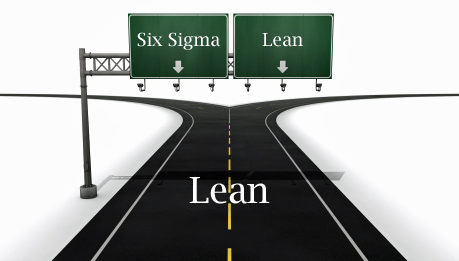
Lean or Six Sigma which fork in the road do you take?

People will see my comments floating around the Internet on the subject of Lean Six Sigma. I am not an expert and probably take too much liberty in the application of them to even proceed but it was important to me to basically post my view.

There will always be a strong debate between Lean and Six Sigma people about using the 2 terms jointly. I am not positive of the lineage of it but I believe Michael George at the time of the George Group (later to be Accenture) coined the term. I assume he viewed the two methodologies as compatible and more effective in conjunction with each other versus separately. I am not even sure that many (Case in point being that many of today’s “Lean” consultants were trained as Lean Six Sigma Black Belts) disagreed at the time except for the very traditional Lean stalwarts.

Dr. Mikel Harry, credited as one of the founders of Six Sigma states that Six Sigma is not a culture and was developed as a quality tool to gain breakthrough performance for an organization. I adhere to that statement and think Six Sigma offers great opportunities for an organization and provides a very precise and workable structure in achieving this. I am not against the hierarchy of belts and the formalities of DMAIC, DFSS, etc. Many organizations need this type of structure to be successful. I am avid defender of Six Sigma in the Lean circles many times to the chagrin of others.

Lean was developed by the MIT group under Dr. James Womack from a study of automotive companies and more specifically the Toyota Production System. Its approach is based on continuous improvement with a direct correlation to PDCA and Dr. Deming’s philosophies. Lean made its first inroads in many companies and gains in popularities (IMHO) because of the ease of entry into the methodology. Removing waste and improving flow was Lean’s mantra in the 90’s and the tools of 5s and Value Stream Mapping soared in popularity. However, as Lean continued developing tools of A3, Hoshin and Standard Work became common place. But even more so, the culture of PDCA and the spirit of Kaizen started to take hold.

Six Sigma was the methodology of choice for many manufacturers as a result of the significant strides that GE and Motorola had made. Later, Lean seemed to gain and Six Sigma wane in popularity. Lean became the path to a customer as an enabler of some quick wins. You could then take the deep dive with Six Sigma when you wanted to get “serious”. As Lean continued to steamroll and Six Sigma still continued with somewhat lackluster performance many organizations and consultants dropped the attachment to Six Sigma and became “Lean”. Popularity does create a crowd. This may not be an entirely accurate description but it serves as a basis for my views and the following comments.

What makes Lean Six Sigma work? When you first start using any methodology, you are typically introduced through the tools. Using Lean initially versus Six Sigma makes perfect sense, it is an easier introduction. And why reduce variability on non-value activities? But sooner or later you get to the fork in the road. One path says Six Sigma and the other path is this thing they call culture (Lean). So do you want to take the deep dive with a breakthrough structured approach (still has a steep incline) or do you want to try and instill a culture of empowerment. There is not a right or wrong answer. You can take either. Where I disagree, is that you can take both.

Six Sigma has always been about structure and tools. It is very, very good and does an outstanding job when applied properly. In Six Sigma thinking, you can use Lean tools initially and get to 95%. To finish the job, you use Six Sigma. And as a result, Lean Six Sigma was developed. If your organization grew out of the Motorola and G.E. world it seems like a perfect fit.

If you adopt the Lean mentality and the spirit of Kaizen (continuous improvement is not an event) you become immersed in the culture of Lean, as Dr. Balle wonderfully described in the Zen Story about the mountain. Summed up in the blog post: Lean Tools and Culture as it Relates to Zen

Have you ever played yourself in a game? On a basketball court or even a simple game of checkers, sooner or later you have to pick a side to win. It is inevitable. This is the ultimate wedge between the two methodologies and can simply be stated. Six Sigma is a structured methodology and Lean is a cultural driven learn by doing approach. That is not to say that Six Sigma does not have its prototyping options and that Lean is not without statistical control (it did evolve from Deming). But it is saying that they are both on two completely different paths that you must choose between.

If you take the path of and see Lean as Lean, Six Sigma does not make sense and is not a compatible technology. There is a significant culture difference and approach. If you take the path of Six Sigma, you view Lean as only a set of tools nothing more and why not, Lean has a great toolbox. If you take the path of Lean you still can be just as efficient and just as effective as Six Sigma, you just do it differently.

I make no qualms about stating that I believe and follow a Lean philosophy. Lean works in my world much better. PDCA which is basically form a hypothesis, test it and adjust is what sales and marketing is all about.

I support the idea of Lean Six Sigma without hesitation. What I have trouble understanding is how you can be philosophically aligned in Lean thinking and practice Six Sigma. So I believe you must ask yourself; Which fork in the road do you take?

Related Information:
Profound knowledge for Lean Marketing
Lean Sales and Marketing Cycles are Knowledge Building Tactics
Lean is not a revolution, Lean is solve one thing and prove one thing!
Continuous Improvement Sales and Marketing Toolset

Thursday, August 4, 2011

Operational Excellence in Government

In a recent Business901 Podcast, Operational Excellence in Government, is it Possible?, Hundley Elliotte one of the authors of Building High Performance Government Through Lean Six Sigma: A Leader’s Guide to Creating Speed, Agility, and Efficiency discussed what it takes in government  to achieve operational excellence utilizing Lean Six Sigma. This is a transcription of the podcast.

Operational Excellence in Government

Hundley M. Elliotte is the global lead for the Process Performance group within the Accenture Process & Innovation Performance service line. He has more than 15 years of consulting experience, focusing on managing business value, setting strategy, identifying customer needs, and identifying and implementing improvement opportunities in diverse business sectors. Previously, Mr. Elliotte worked for more than a decade in the corporate sector, holding sales, marketing and general management positions with a leading pulp and paper manufacturer and with a plastics company. He is based in Atlanta.

Accenture is a global management consulting, technology services and outsourcing company, with more than 223,000 people serving clients in more than 120 countries.

Read Chapter One, “Building the Anatomy for High Performance”

Read about the Accenture Institute for Health and Public Service.

Related Information:
DMAIC, DMADV, Lean, Six Sigma for Government?
Lean Six Sigma for Government
Lean Six Sigma will increase effectiveness of Stimulus spending

Learn more about Michael George’s Strong America Now program.

Wednesday, July 27, 2011

Operational Excellence in Government, is it Possible?

When I first listened to Mike George’s Stong America Now program, I thought it was a joke that hardly made any sense. However, I have learned to investigate things that rub me the wrong way initially and many times I have found a little gold in the outcomes. Hundley Elliotte web

One of those outcomes was the opportunity to interview Hundley Elliotte one of the authors of Building High Performance Government Through Lean Six Sigma: A Leader's Guide to Creating Speed, Agility, and Efficiency. What I liked about the book was it really removes the issues about can it be done, it is already being done. In the podcast, we discussed these places and also discussed the how in applying Lean Six Sigma to any public organization.

The authors paint a very clear picture of the role of Lean Six Sigma in Government. It is a very well written book without the statistical jargon so often found in Lean Six Sigma books. I even found certain parts of the book remarkably useful for the private sector.

Download Podcast: Click and choose options: Excellence in Government or go to the Business901 iTunes Store

Hundley M. Elliotte is the global lead for the Process Performance group within the Accenture Process & Innovation Performance service line. He has more than 15 years of consulting experience, focusing on managing business value, setting strategy, identifying customer needs, and identifying and implementing improvement opportunities in diverse business sectors. Previously, Mr. Elliotte worked for more than a decade in the corporate sector, holding sales, marketing and general management positions with a leading pulp and paper manufacturer and with a plastics company. He is based in Atlanta.

Accenture is a global management consulting, technology services and outsourcing company, with more than 223,000 people serving clients in more than 120 countries.

Read Chapter One, “Building the Anatomy for High Performance”

Read about the Accenture Institute for Health and Public Service.

Related Information:
DMAIC, DMADV, Lean, Six Sigma for Government?
Lean Six Sigma for Government
Lean Six Sigma will increase effectiveness of Stimulus spending
The Hell with the Economic Stimulus Package – I’ll Lead
Balancing Internal and External Lean Six Sigma Consulting Roles

Will Lean Six Sigma work in Government?

A short introduction by Maria Elena-Stopher, describes lean transformation at the Federal Department of Housing and Urban Development, and shares lessons learned in Lean applied to federal government processes. Full one-hour video is available for purchase through the Maryland World Class Consortia.

Is this process doable on a national level, a lot of people think so. But where would you start…..

Steven C. Wilson one of the leading Lean Six Sigma trainers in Iowa states, "Lean Six Sigma is not a complex process if you understand the theory behind it. But to begin any journey you need a starting point and a solid base of knowledge to provide direction. Leaders do not need to know the intricacies of DMAIC, DMADV and Variation. Leaders do not need to know when to use Binary Logistic Regression. But they do need to know the basics to enable others.”

Steve has just released his first book, Lean Six Sigma for Government.. The book is available on Amazon in print or CD-Rom format. It can also be downloaded as a PDF on LeanSixSigmaforGovernment.com.

Disclaimer: I work with Steve on a regular basis.

Related Information:
Lean Six Sigma will increase effectiveness of Stimulus spending
The Hell with the Economic Stimulus Package – I’ll Lead
Balancing Internal and External Lean Six Sigma Consulting Roles
Leading the Way in Iowa Quality Training

Thursday, April 21, 2011

How to develop a Survey to capture Voice of Market

This is an excerpt from the book Best in Market authored by Dr. Eric Reidenbach. The book incorporates the overall essence of Six Sigma in marketing today. It takes the DMAIC structure and applies it in a simple easy to read structure that will be beneficial to a Black Belt that may not be all that familiar with marketing and/or to a marketing team that has limited exposure to Six Sigma. It is a readable book that it is not filled with Six Sigma terminology and methodology that typically takes away from the message. The points that are made on value and quality through out the book and on how to acquire them through proper techniques will provide additional insights into your own marketing methods.

Best in MarketThe previous value models were generated from survey information collected from buyers in the targeted product/market. It might be useful to take a few moments and review the process. The purpose of this review is not to make market researchers out of manufacturers but rather to make them better buyers or specifiers of market research information. Too many research companies sell off – the – shelf research to companies. Good research is driven by the information needs of the client, not the bottom line of the seller.

Step one: Asking the right questions

The first step in any survey design is to make sure you are asking the correct and relevant questions. This is where interviews or focus groups can be particularly helpful. Both of these techniques are best classified as “exploratory” in nature rather than definitive. They can be very useful in eliciting the right types of questions to ask in a survey.

Focus groups usually are comprised of about 8 to 12 individuals who are part of the targeted product/market. These individuals are asked to talk about their experiences, likes, dislikes, problems regarding the product in question. It is essential that this discussion should focus on how they define quality and value. This is where the more comprehensive definitions of quality and value come in. Relying on the interaction among the group can be very beneficial and revealing as one respondent will play off another. Your attention should be directed toward compiling a list of attributes that define quality and value. During this process it is essential that a level of granularity be achieved, since the more granular the information the more actionable it is.

For example, a respondent might say “quality of the product” is important. Your next set of questions should be what does quality mean? Can you give me an example of good quality? Can you give me an example of bad quality? If you were designing a product like this, how would insure that it is a quality product? Allowing these questions to be part of a group discussion can be very enlightening. In fact, I have found it quite useful to have a group of manufacturing executives behind the one way glass to listen and view the groups being conducted. They will learn a lot just from this exposure.

The tendency of the uninitiated research user is to rely too heavily on focus group information. Some people tend to take the information as gospel. Keep in mind that the responses come from just 8 to 12 individuals and do not reflect a statistical sample of actual buyers. In fact, it is probably wise to conduct at least two or more focus groups to corroborate the information. These sessions can be videotaped and replayed for other individuals in the company exposing them to how the market defines quality and value. They provide good discussion guides.

Step two: Questionnaire development

The actual form of the questionnaire will depend upon what data collection technique you are using. However, most types of questionnaires have some basic elements in common.

Once a list of quality and value attributes has been generated, they can be assembled into a questionnaire. The questionnaire has three basic sections: a screening section, a body, and a demographic section. The screening section contains questions that make sure you are reaching the proper person. Ask the wrong person the right questions and you run the risk of getting bad information.

The body of the questionnaire contains the attributes that you have generated from the focus groups. These should be randomly listed (as most professional survey companies do). These questions should be answered using a scale anchored by 1 = poor performance and 10 = excellent performance. There are other types of anchors but the real issue you are trying to assess is the performance of the different competitors.

Finally, any information that you want to collect regarding who is answering the questionnaire should go last. Typical demographics include age, gender, geographic location, size of company (revenues or employees), and any other information that will help you segment or target buyers. This information goes last so that in the case of a respondent dropping out you will still have the attribute information.

There are several other aspects of questionnaire development that are important and can and should be worked out with whoever is doing the research. Good competent research companies will be able to address these issues.

Step three: Fielding

Once the questionnaire has been developed and tested, it is fielded. This again is done by the research company and depending on the nature of the buyers can be handled by telephone, internet or mail. In some cases a personal interview format can be useful. Each format has its advantages and costs and should be discussed with the research company.

Step four: Analysis

When the data is collected and edited it is subject to an analysis. There are numerous ways of surfacing information. The models shown earlier were the result of a multiple analytic approach. First the items were factor analyzed which permits the surfacing of the CTQs. These are then regressed against a composite of value questions. The regression model generates a goodness of fit measure that tells you how good the independent variables (CTQs) are in explaining the dependent variable (value) and how important each element of the model is in capturing the meaning of value.

There are other ways of analyzing the data but any technique(s) chosen should identify and prioritize the drivers of value (quality, image and price) and should do the same for the CTQs. Clearly, the more focused the CTQs the more actionable the resulting information.

The model should also yield information that permits you to identify your competitive value proposition with that of your key competitors. This will require you to not only survey your customers but also those of your competitors.

Again, many types of analytics can be used but you will want to be able to break down the respondents into your customers and be able to identify other customers by brand or competitor. This is essential.

A complete discussion of data collection and the various types of analyses are beyond the scope of this book. Other books, such as Listening to the Voice of the Market: How to Increase Market Share and Satisfy Current Customers, delve into the research process in significantly greater detail.

Generating this kind of information is not cheap. But the returns from good market information are invaluable in becoming best in the market. And, being best in the market has its own longer lasting returns.

Related Information:
5 Cs of Driving Market Share
Value Stream Mapping Customer Value
Is your price worth it? And why you settle for less!
Six Sigma Marketing Institute releases Audio Program
Applying Six Sigma Marketing to become Best In Market
The Bridge Between Six Sigma and Marketing

Friday, March 4, 2011

Driving Market Share Special Offer

C PPTOrganizations need to change from a customer satisfaction focus to a customer value focus. The Five Cs of Driving Market Share serves as the template for this transaction. 5 Cs of Driving Market Share is not a project-by-project approach for reducing the costs of marketing activities, but rather an approach that seeks to enhance marketing’s effectiveness and efficiency. For organizations that have deployed other quality initiatives, the 5 Cs approach provides a user friendly bridge for moving the quality focus from the manufacturing floor to the marketplace. Those seeking to become best in market must shift their focus from a product orientation to a market orientation, from an internal efficiency focus to an external focus. Best in market companies will be those that can make this transformation and make it soon.

Customer Identification Program Content: The first step in the 5 Cs of Driving Market Share is identifying specific products/markets that offer the organization its best options for growth. You will learn how to evaluate products and markets using metrics such as current market share, market growth rate and competitive intensity to assess the best targets for the organization. When completed, you will eschew the notion that a company can be everything to everybody, and instead focuses on key market opportunities. This occurs in the Define/Identification stage and differs from the more project-oriented approach that traditional Six Sigma uses.

Customer Value Program Content: In the Value (Measure) stage of Driving Market Share, you will create a value model for each of your targeted product or markets. This value model is the voice of the market (VOM) that drives all operational and strategic initiatives undertaken by the organization. The VOM replaces agendas, hunches and strategic guessing as the guiding factor in growing market share. Value has been shown to be the best leading indicator of market share and top-line revenue growth. Learn how to use superior value creation and delivery to propel growth within the targeted product or markets.

Customer Acquisition Program Content: In the Acquisition (Analyze) stage you will use primarily the Competitive Value Matrix to guide you through the delivery of value delivery. An organization’s value is relative to that of its competitors. This is part of the buyers’ comparative calculus in assessing where to buy. The buyer is asking a simple question: “Is this brand worth it?” By understanding your organization’s competitive value proposition, leaders can make better decisions regarding market share growth.

Customer Retention Program Content: The Retention (Improve) stage could also be called the Enhancement stage. For value leaders, the focus should be on enhancing value to sustain their leadership position. Extending the gap between the value an organization provides and the value provided by the nearest competitor can lead to best in market status. Value followers will want to improve those elements of the value creation and delivery system that will close the gap. This is when organizations need to enhance or improve their competitive value proposition in accordance to the directives of the market place.

Customer Monitoring Program Content: The Monitoring (Control) stage is where you learn how to put monitoring systems into place to ensure that their competitive value proposition accomplishes what is intended. This control effort focuses not only on the more strategic value proposition, but also can be set up to monitor specific transactions such as sales, repairs, inquires and other customer experiences. This monitoring process acts as a trip wire, providing information where there are potential people, product of process issues that require intervention.

For 72 Hours, March 4th to 7th you can receive a special offer, a $200 savings. on the digital download of this program. 

Driving Market Share Program

Thursday, March 3, 2011

How do I determine which markets to go into?

The starting point for identifying product/markets is to focus on first, the markets. There are two criteria that we use in Lean Marketing to assess or to evaluate markets. Asking Questions

The first one has to do with how attractive is that market?

Attractive of markets could be defined in terms of the market growth rate. Is it a growing market or is it a market that is in decline? For most purposes we probably want to target markets that are growing as opposed to in decline. We may want to look at the competitive intensity of the market. Is it a highly competitive market or is it more of a blue ocean type of market? One where there are few competitors or preferably even none.

What is the revenue flows within that market? What's our market share position? Who are the dominant players? There's any number of different criteria that we can use to assess the attractiveness of a particular market.

The second criterion is the ability to compete.

Now we take a look at how capable are we in competing within a potential market. That goes back to this concept of what are our competencies?

And one of the things we may want to look at from competitive standpoint is what the qualifiers are? What are the must haves? Do we qualify for that particular product/market or are we going to have to invest additional resources to qualify?

Second, do we have a product line that has both the width and depth of the market? Can we successfully provide product and product support? That's a very important point. Do we have the product support systems to support the product lines once we are marketing there?

What about our distribution system? Do we have the right network setup? Are the dealers that we have adequate or the brokers, the agents, the middlemen, that type of thing? And again, do we have the right personnel?

So by matching the attractiveness of the market with our ability to compete, we can then begin to prioritize different potential markets. Clearly we want to target those markets that are highly attractive and for which we have a very strong ability to compete. Then we want to target attractive markets that we might have a moderate ability to compete in. We also want to be able to ask the question, what do we need to do to improve our capacity to compete with any of those markets?

This is an approach that is good not only for those companies that are embarked on a marketing development strategy where they're looking to enter new markets and they're trying to assess the efficacy of any market, but it's also a good thing for companies to do on an audit basis of what their current markets are because a lot of those companies have inherited markets and been serving them.

From time to time markets change, their attractiveness will change, the market growth rate may drop, and the competitive intensity may have increased significantly, the revenue flows have declined. So it's a good opportunity for the company to take a look at what they are currently doing and then make the assessment as to whether or not those markets are the right ones for the company to be in.

Leaders who take the time to really focus and understand their markets are super tough competitors. That's why they're leaders and not followers.

The following was derived from a conversation between Dr. Reidenbach creator of the 5Cs of Driving Market Share and me.

Related Information:
Six Sigma Marketing Institute releases Audio Program
Is your marketing concentrated in area that makes a difference?
Lean your Marketing by Dominating with Customer Value
Can Voice of Customer deliver?
Unclear Customer Value leads to Failure

Tuesday, January 18, 2011

Manufacturing to Healthcare, the Tale of Lean Six Sigma Consultant

Jason Kilgore is much more than just your typical Lean Six Sigma consultant. I ran across Jason on the web answering a LinkedIn question about internal and external consultants. He spoke highly of each, gave practical common sense answers on when to use them and sold nothing! He caught my attention and I went surfing. Jason-Kilgore

What I found was a Business Process Manager for Riverside Health System in Newport News, Virginia, where he has utilized his expertise in Project Management, Lean, and Six Sigma (Black Belt). In 2008, Jason transitioned to healthcare after 15 successful years in the automotive industry. While in the automotive sector, Jason filed for over 60 US and global patents as a design engineer, led multiple Six Sigma projects as a Black Belt, and implemented lean concepts in his role as a manufacturing manager.

I followed my instincts on this podcast and it turned out that Jason was a great interview. I hope you enjoy it as much as I did

Jason is the author of the book, The Elegant Process: The Guide to Enhanced Quality and Reduced Costs'>The Elegant Process. In the book Jason demonstrates his value-based approach to simultaneously achieving quality and financial goals through process improvement and optimization. The Elegant Process shares Jason’s straightforward method for enhancing quality and reducing costs within any business setting by redesigning the systems that contribute to lackluster results.

Related Posts:
Profiting from Customer Value
Why Lean Marketing? Because it is the Future of Marketing
Agile, Scrum, Kanban, or is it just a Marketing Funnel?
The Pull in Lean Marketing
Value Stream Marketing and the Indirect Marketing Concept

Saturday, November 27, 2010

Six Sigma Marketing Institute releases Audio Program

This is the audio section of the program I use to provide the basis for Customer Value in my Lean Marketing programs.  The series serves as a template for organizations needing to change from a customer satisfaction focus to a customer value focus. It has been deployed in a number of Fortune 100 and Fortune 500 companies and has produced positive market share growth. C PPT

Author Dr. R. Eric Reidenbach says, "For organizations that have deployed Six Sigma or other quality initiatives, the 5 Cs approach provides a user friendly bridge for moving the quality focus from the manufacturing floor to the marketplace. Those seeking to become best in market must shift their focus from a product orientation to a market orientation, from an internal efficiency focus to an external focus. Best in market companies will be those that can make this transformation and make it soon."

The Five Cs gives you excellent background knowledge on how to build an effective and efficient marketing data set based on customer value. Customer Value is the only true measure for Driving Market Share. Learn the process of transitioning to using Value as a basis for Driving Marketing Share. 5 CD program or instant download that includes the titles:

1. Customer Identification
2. Customer Value
3. Customer Acquisition
4. Customer Retention
5. Customer Monitoring

Digital MP3 Download…$49.99


Audio CD Package……$79.99


Six Sigma Marketing is a fact-based, disciplined approach for growing market share in targeted product/markets by providing superior value. The Six Sigma Marketing Institute is dedicated to the advancement and deployment of Six Sigma Marketing. At the heart of SSM is a modified DMAIC process that provides the architecture for growing top line revenues and market share.

More about the rest of program can be found at DrivingMarketShare.com.t.

Disclosure: I participated in the creation of this program and have a vested interest in the success of i

Related Information
Press Release: Six Sigma Marketing Institute releases the 5Cs of Driving Market Share
Applying Six Sigma Marketing to become Best In Market
Trainers sought for Six Sigma Marketing Program
The Bridge Between Six Sigma and Marketing
Lean your Marketing by Dominating with Customer Value
Value Stream Mapping differs in Lean Marketing
Can Voice of Customer deliver?

Thursday, November 25, 2010

Storyboards give Insights to Space and Time

Would like to have additional insights to your customers’ ACTIONS? Maybe, even additional insight to your organizations RE-ACTIONS? The benefits to visualizing your processes have been proven over and over again with the practices of Mindmaps, Value Stream Mapping, Process Charts, Charts, and other visual tools to include Powerpoint! Through the use of Storymapping, you can extend these tools and create a more graphical description. I believe this adds more insight to the process through a better understanding of space and time. 

In the book, Visual Meetings: How Graphics, Sticky Notes and Idea Mapping Can Transform Group Productivity, author David Sibbet points out to some of the successful companies that utilize the Storymapping Process. We are not talking Disney or Pixlar but maybe less creative types.

Examples of organizations that have achieved great results this way include:

    • National Semiconductor shared its turnaround vision worldwide in the early 1990s, and in tour years achieved 95% vision recognition throughout the company.
    • Hewlett Packard Labs shared potential new business ideas to top management using plotter-generated murals instead or slides.
    • Ralcy's top management shared its history, vision of the future, and strategy of their grocery store chain store with managers.
    • Save the Redwoods League shared its vision, strategies, and goals with all its stakeholders in three different 5 year planning processes.
    • VISA corporation orients all new employees with a large graphic history (updated three times so far).
    • Adobe Systems created a graphic history of Adobe and Macromedia when the two organizations merged.
    • The RE-AMP collaborative illustrated bow its system works to the 120 environmentally oriented non-govcrnmciit organizations and I5 foundations at its annual meeting in the upper midwest. They also used large charts to map progress toward their goal of cleaning up
      global warming pollutants in the energy industry.
    • Nike communicated its visions for its Treasury function, and then later for its IT function using large Storymaps.
    • National Academy Foundation designed large Storymaps to illustrate its process of establishing high school learning academies.
    • The San Francisco Film Society used a large Storymap as a centerfold for its five-year business plan focused on growing this very successful, full-service film arts organization.

They went on to further explain the results of the National Semiconductor Vision Map in more detail stating:

Every top executive could tell this story, using this mural as a backdrop. It shows the overall vision to the far right, the history to the left, leading to the unassembled spaceship represented current realities. Critical business issues lie in front of the ship. Key values are the windows. Marketing messages are in the talk balloons. The top of the spaceship illustrates the new organization. The way forward has question marks intentionally; because Amelio wanted to enroll the rest of the organization in redesign. This vision got 95% recognition in employee surveys by 1994.

So how can you use Storymaps in your business? Use it as a communication tool. People learn through pictures and it directly engages people if designed correctly. A Storymap won’t do it all. You still have to show up and tell the story. However, having all the information visible allows a person to leave the story unfold as they tell it. I like the big visuals where everyone can soak in the entire picture as you are talking.

After the presentation, leave the Storyboard up or have small handouts. I thought the added question marks in Amelio’s Vision were an excellent way to stimulate additional thoughts. Welcoming and having additional post-it-notes lying around so that ideas can easily be added is the best form of suggestion box that you can have. They can be anonymous or not and I would encourage a different color so that you can tell that they were added at a glance.

The authors went on to suggest a few ideas that Storyboards could be used for…

    • Orienting to histories and culture of an organization.
    • Communicating the need for change.
    • Understanding driving forces in an industry.
    • Understanding customer needs.
    • Sharing new visions and strategies.
    • Sharing implementation plans.
    • Communicating new process designs

kiaboard

The above picture may represent a persons experience in purchasing a car. What they consider: price, payments, usability, function, gas mileage, looks. Storyboarding the process out tells me a little more on how they look at it, what is important to them.and what the choice says about them. It is not much easier to develop your sales and marketing process from this description? 

Lean has always relied on Value Stream Mapping as one of its core tools. Six Sigma Storyboards have also been popularized to document the project results. In my opinion, both of these seem to follow to rigorous of a process and don’t include some of the great visualizations tools that exist. The Agile, Kanban and Scrum contingencies have introduced a much more visual aspect to their boards. Even assigning cartoon characters to people to designate who is responsible for the task. The point is allowing a little fun in the process not only creates a better environment but also enhances and extends the learning experience.

Picture Credit: http://www.sketchartist.tv

Related Blogs:
Be Our Guest: Perfecting the Art of Customer Service
The Disney Way
Using DMAIC for your A3 Report in the Lean Marketing House
Lean Six Sigma Storyboard
Crafting your Storyboard
Converting Storyboarding to Marketing or Value Stream Mapping
Storyboarding for Business

Tuesday, November 9, 2010

Can Six Sigma and Marketing Co-exist

In my journey over the past few years to bring a Continuous Improvement philosophy to marketing, I have primarily focused on Lean and identifying the individual Value Streams though segmentation. Lean was a much easier methodology to implement and utilize. As I continued with a customer, I found the Six Sigma toolbox provided me a stronger set of analytical tools that was needed in handling the vast amount of data. In any case, I practice a mixture of Lean and Six Sigma. Transferring this philosophy to other marketers and Lean/Six Sigma Practitioners has been very difficult with each side very skeptical of the other.

Working the past several months with Dr. Eric Reidenbach of Six Sigma Marketing Institute to develop the program the 5Csof Driving Market Share has provided a much clearer path or the bridge between the two methodologies. In the program, we challenge the way both the Six Sigma community and the marketing area think about business and the way they currently do business. It does so by providing a detailed and structured approach one that is entirely data driven to unleash the power of Six Sigma on the crucial need of Customer Value for revenue growth. An outline of that bridge between Marketing and Six Sigma is provide in the table below.

SSM Comparison

Related Posts:
Lean your Marketing by Dominating with Customer Value
Value Stream Mapping differs in Lean Marketing
Can Voice of Customer deliver?
Unclear Customer Value leads to Failure

Monday, November 1, 2010

Quality Conversations...The Global Voice of Quality

I am the guest today on Quality Conversations hosted by Steve Wilson where we will discuss Applying Lean or Six Sigma to Marketing. The call-in number is (646) 200-3898. steve Wilson

Quality Conversations, serves as a platform for communicating the best and brightest strategies, methods and tools for all those interested in improving quality and business process excellence within their companies. QC initiates dialogue with local, state, and national experts in many of the well known quality disciplines as well as additional topics and guests of interest. Special thanks to Larry Parah for his work at www.iqualityprocess.com and for his support of this program.

P.S. Thanks Steve for having me.

The link to the show: Applying Lean or Six Sigma to Marketing

Related Post:
Six Sigma Marketing
Lean Marketing
Make my Day, Sign up for a November 28 Day Program