Business901 Book Specials from other authors on Amazon

Showing posts with label Marketing Funnel. Show all posts

Wednesday, January 16, 2013

Lean Marketing: 2 Step Marketing Funnel

You are either Selling or Marketing, that’s it!

Why have we complicated all this with Customer Experience, Customer Relationship, Customer Development, Sales Management, Marketing Funnels and Sales Funnels? Or whatever your choice or flavor of the month you have. Few of us even do a good job of attempting to mirror the customer decision process (wonder where you have heard that before). We are then supposed to determine our reaction and create a great customer experience. I have over few hundred blog posts on this subject alone. The fact is most of us don’t even do a good job of any of this. Think about it, but few us even understand our customer decision's path. Well guess what, it might be a waste of time to do it anyway. 70% of the customer decision is typically made before you are even invited into the game. From the Sales Force ebook Social Sales Revolution: 7 Steps to Get Ahead @Salesforce publishes #ebook from Salesforce:
We are in the midst of a social sales revolution. Buyers have more access to information than ever. As much as 70% of purchase decisions can be made before a sales rep ever gets involved. Are you taking advantage of the tools available to you to win deals in this highly competitive environment? These seven steps and case studies will help you get ahead of the competition and turn your company into a social enterprise.
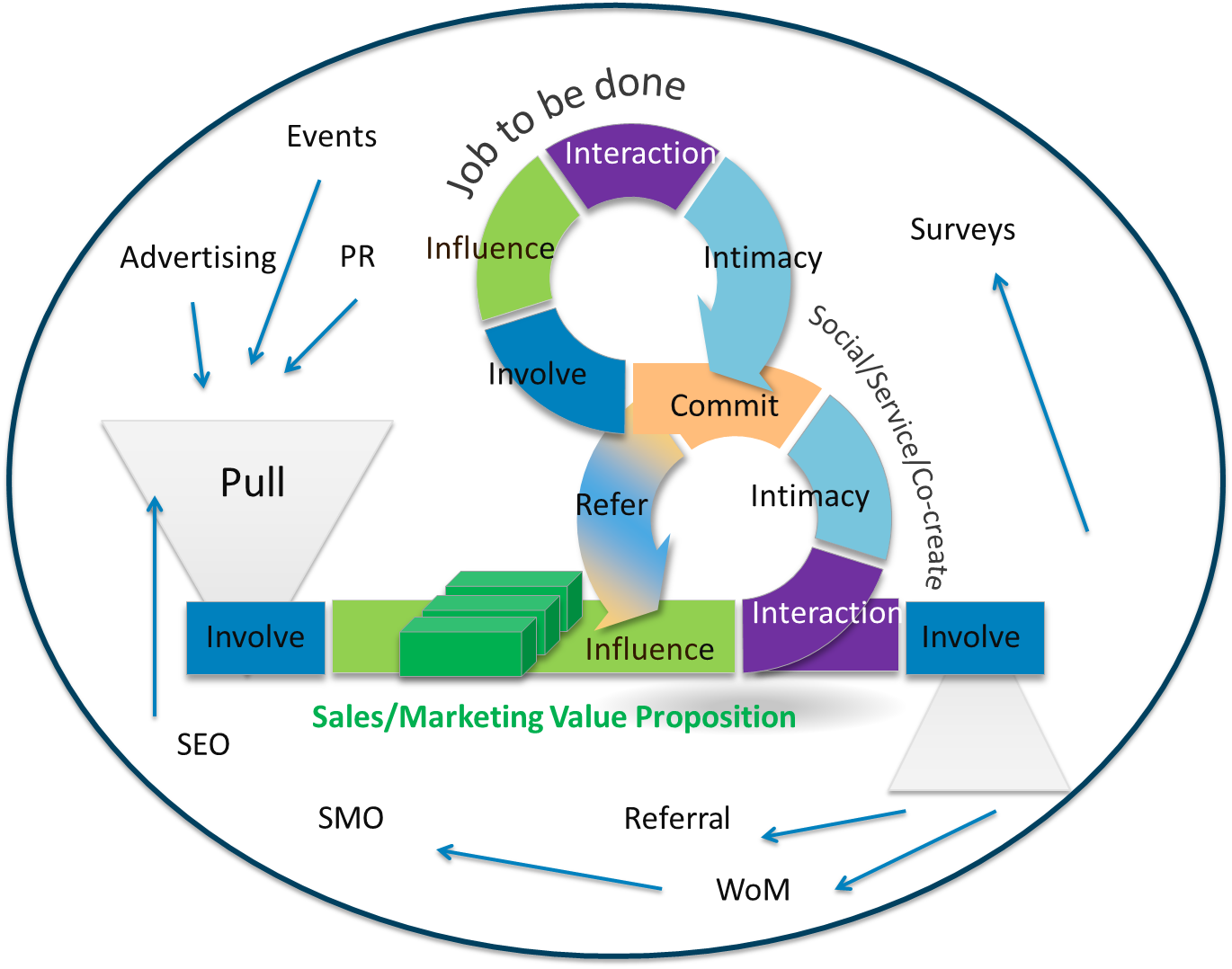
 
When we review these pages, we are reminded that it is about engagement versus widening the mouth of the sales funnel. Everyone will probably agree that we need to make our efforts more effective and efficient, we call it target marketing or differentiation. Think about how many times you have heard your salespeople exclaim; “Don’t give me these internet leads (or trade shows, or whatever) to follow up on, give me qualified leads.” We may try that when business is good but……. We all know the answer: when business is bad we get on the phone, make cold calls. You may be asking where is this simple 2-step Lean Marketing approach. Well the steps have never been clearer. If you cannot hear each other’s voice or shake their hand you are marketing not selling. Let me define it a bit more by the picture below.

Marketing Funnel

Marketing is all about pull. We are either pulling prospects into our value streams to be handled by sales, or we are pushing them out of the value streams to be handled by marketing. This is not to say marketing is not collaborating or engaging with any customers; they are. Intimately may not be the word though. Twitter streams, Facebook and LinkedIn are not intimate sales channels. They are channels that we influence others to decide to allow us to engage with them. We must remember, that 70% of the decision making is being done in this perspective.

The 30% is highlighted in the drawing by the Scrum-like diagram. It is where we engage with our customers on a regular and intimate stage. It is where we get to know them on a first-name basis. What I would propose is prospecting is not part of this sprint. It is not part of the engagement process. Where the handoff between Sales and Marketing may occur will be different from one organization to the next. If you have a standard product that is practically an automated sales process, a download or self-service, it may just go through the horizontal value stream.

If we need to nurture and get intimate (30%) with the customer, we go through an iterative sales process. As a result, the salespeople, will spend more time with existing customers (job to be done). Sales have been moving this direction for a long time. Franklin Covey in their sales training define Trust = Intent + Expertise. I think the primary salesperson's job is to develop the trust in the iterative cycles (Blog post, The Eagles always understood!). The first cycle could be called the intent cycle. You may be offering the customer a trial offer or an introductory product/service offering. This way, they can experience and decide if the expertise is there to continue. Demonstrating intent should be 80% of your efforts. Most often, we try to sell expertise to soon.

The job to be done (Blog Post: Do You Know the Right Job For Your Products?) is where greater expertise is demonstrated and also where the greatest opportunity is to develop future sales. We do this through are participation and collaboration with the customer. We never lose the "open-mindness" of demonstrating intent but this is where are expertise should be developed within and across both organizations. If we do not develop that collaborative spirit, the customer will eventually filter back through the process and be handled by marketing.

I will expand into the sales area in upcoming blog posts. Additional information is contained with the 2 Info-graphics, Lean Marketing House Infographic and Lean Marketing for Service Dominant Thinkers.

Monday, March 5, 2012

Do You Know the Right Job For Your Products?

From Innosight and authored by Clayton M. Christensen, Scott D. Anthony, Gerald Berstell, Denise Nitterhouse

The market segmentation scheme that a company chooses to adopt is a decision of vast consequence. It determines what that company decides to produce, how it will take those products to market, who it believes its competitors to be and how large it believes its market opportunities to be. Yet many managers give little thought to whether their segmentation of the market is leading their marketing efforts in the right direction. Most companies segment along lines defined by the characteristics of their products (category or price) or customers (age, gender, marital status and income level). Some business-to-business companies slice their markets by industry; others by size of business. The problem with such segmentation schemes is that they are static. Customers' buying behaviors change far more often than their demographics, psychographics or attitudes. Demographic data cannot explain why a man takes a date to a movie on one night but orders in pizza to watch a DVD from Netflix Inc. the next.

Product and customer characteristics are poor indicators of customer behavior, because from the customer's perspective that is not how markets are structured. Customers' purchase decisions don’t necessarily conform to those of the "average" customer in their demographic; nor do they confine the search for solutions within a product category. Rather, customers just find themselves needing to get things done. When customers find that they need to get a job done, they "hire" products or services to do the job. This means that marketers need to understand the jobs that arise in customers' lives for which their products might be hired. Most of the "home runs" of marketing history were hit by marketers who saw the world this way. The "strike outs" of marketing history, in contrast, generally have been the result of focusing on developing products with better features and functions or of attempting to decipher what the average customer in a demographic wants.

In a discussion, I had with Alex Osterwalder this week he spent a great deal time talking about this concept and how it relates to Customer Value. Alex is the author of the Business Model Generation and next weeks podcast guest.

This is a similar concept to Service Design via Service-Dominant Logic where the foundational belief is that value is derived through the use of your product/service. Your product/service is only an enabler of value. Utilizing this concept, can your product/service be given away for free and as a result be paid for through the use of it? Let's say Xerox gives a printer and services the printer for free and gets paid on the use of it. Zipcar is another example - you only pay when you use it. There may be a minor membership fee but the real cost would be associated with the use of the product.

Does anyone have other examples where the value in use concept is used?

Is highlighting 'value in use" an effective marketing tactic?

Can you segment markets through how you use a product?

Do you have other question that this concept raises?

Join the conversation on this subject at the Lean Marketing Lab.

Related Information:
Service Design Thinking Podcast with Marc Stickdorn
Define the Expectation, Delight the Customer
Lean Engagement Team Book Released
Appreciative Inquiry instead of Problem Solving

Monday, November 7, 2011

Work on demand, 'It's the demand side, stupid'

Working on supply side economics is not putting people back on the payrolls. Commentator Robert Reich has another idea: Work on increasing demand for goods and services here at home. Listen to this audio:

I am not arguing political issues, I am just trying to build supporting evidence for why supply side solutions are not working in the economy and are not working in marketing your product and services. It’s just simply about the Demand!

Related Information:
Lean needs Marketing, more than Marketing needs Lean!
Continuous Improvement Sales and Marketing Toolset
Lean Sales and Marketing and the iCustomer
The Death of PDCA
What Political Campaigns can teach business, part 2 of 2

Monday, October 3, 2011

Customer Experience more powerful than the Supply Chain?

During the past few months I have been spending time understanding the Service Design concept. The history according to Wikpedia:

The earliest contributions on service design (Shostack 1982; Shostack 1984), the activity of designing service was considered as part of the domain of marketing and management disciplines. This design process, according to Shostack, can be documented and codified using a “service blueprint” to map the sequence of events in a service and its essential functions in an objective and explicit manner.

In 1991, service design was first introduced as a design discipline by Prof. Dr. Michael Erlhoff at Köln International School of Design (KISD), and Prof. Birgit Mager has played an integral role for developing the study of service design at KISD in later days. In 2010, 23 service design professionals published the first comprehensive textbook This is Service Design Thinking: Basics - Tools - Cases , edited by Marc Stickdorn and Jakob Schneider.

Wikpedia goes on the give a brief description of Service Design:

Together with the most traditional methods used for product design, service design requires methods and tools to control new elements of the design process, such as the time and the interaction between actors. An overview of the methodologies for designing services is proposed by (Morelli 2006), who proposes three main directions:

    1. Identification of the actors involved in the definition of the service, using appropriate analytical tools
    2. Definition of possible service scenarios, verifying use cases, sequences of actions and actors’ role, in order to define the requirements for the service and its logical and organizational structure
    3. Representation of the service, using techniques that illustrate all the components of the service, including physical elements, interactions, logical links and temporal sequences

Where Service Design has made an impact in my thinking though is its obvious connection to two areas. One in the ability to involve customers through co-creation or open innovation and the other as it relates to The Experience Economy popularized by the book of that name by Pine and Gilmore. socrates

In the 90’s business processes was all the buzz and Lean, Six Sigma led the way. They have continued gaining popularity but and this is a big “but” may soon lose out to the methodologies of Service Design and Design Thinking.

Why? Lean and Six Sigma cannot move away from that supply chain mentality. They are continuously bogged down in the internal world of product delivery. They continue to think the more efficient you become the better company you become. They relate everything to customer value but seldom is that referenced to an external customer.

What’s different about Service Design? In the Service Design context they put the customer experience at the center of the organization. Many product companies have been using this concept with Apple being the shining example. Design is the differentiating factor.

When viewing the customer experience perspective from The Service-Dominant Logic of Marketing framework that states, value is not created till your product/service is put into use creates a different spin. It obsoletes the supply chain and operational excellence as the primary reason your product is purchased. Many efficiency experts are simply at a loss to explain this and struggle to comprehend this concept.

I am not saying improvement of a process is not a good thing. But to do it without improving the customer experience will provide little value and may even prove to be “invaluable”. More information on this can be obtained in a recent blog post: Will Lean always internalize the customer?

Related Information:
The Service-dominant Logic of Marketing: Dialog, Debate, And Directions
If all of us need to be marketers, what’s the framework?
7 Principles of Universal Design & Beyond
The Common Thread of Design Thinking, Service Design and Lean Marketing

Friday, August 19, 2011

Lean Engagement Team

The next book in the Marketing with Lean Series will be the Lean Engagement Team. It will concentrate on the development of a sales and marketing structure that can support customer engagement through out the organization. This structure will be self-organizing at times and provide for customer touch points deep within the organization. The book will also contain chapters on Co-creation, Design Thinking and provide a framework for organizing sales and marketing teams.  

Lean Engagement Team
View more presentations from Business901

The book is approximately 60 days away from completion. Anyone that purchases the Lean Marketing House Trio on the Business901 website will receive a free download of this book when it is released. I would recommend reading the others before this one anyway.

P.S. Don’t think you need a Sales Team quite yet? Read McKinsey Quarterly: We’re all marketers now

Related Information:
SALES PDCA Framework for Lean Sales and Marketing
Profound knowledge for Lean Marketing
If all of us need to be marketers, what’s the framework?
The 7 step Lean Process of Marketing to Toyota

Tuesday, June 28, 2011

Change Education, Change the Sales Cycle

Though this is a well documented Ted Video, I ran across the RSA Animate video version of Ken Robinson’s discussion on education. Funny thing about it was that it really hit a chord when thinking about the typical Sales Cycle or Marketing Funnel. Not the part on Attention Deficit Disorder but when he talks about standardization and  divergent thinking. It starts around the 6 minute mark.

Related Information:
Asking the right questions about Lean?
Service Design Thinking
How to build a Sales and Marketing Team
Kill the Sales and Marketing Funnel.

Wednesday, June 1, 2011

Marketing with PDCA ebook released on Business901 Website

Released as an eBook, Marketing with PDCA authored by Joseph T. Dager is now available on the Business901 website. Marketing with PDCA is about managing a value stream using PDCA (Plan-Do-Check-Act). Using the new SALES PDCA Framework throughout the marketing cycle will provide constant feedback from customers, and can only occur if they are part of the process. It is about creating value in your marketing that a customer needs to enable him to make a better decision.

Targeting that value proposition through the SALES PDCA methods described in this book will increase your ability to deliver quicker and more accurately than your competitor. It is a moving target and the principles of Lean and PDCA facilitate the journey to customer value.

This book also introduces the Kanban as a planning tool or, as I like to think about it, as an execution tool. Improving your marketing process does not have to constitute wholesale changes nor increased spending. Getting more customers into your Marketing Kanban may not solve anything at all. Improving what you do and increasing the speed that you do it can result in an increase in sales and a decrease in expenses.  MwPDCA

Table of Contents

  1. Lean Marketing House
  2. Future of Marketing
  3. Marketing Funnels
  4. Cycles to Loops
  5. Knowledge Management
  6. PDCA
  7. Sales and Marketing Teams
  8. Kanban
  9. SALES PDCA
  10. Marketing with PDCA Summary
  11. Marketing with PDCA Case Study
  12. Constancy of Purpose
  13. Marketing with Lean Program Series

The book is the fourth part in the series of the Marketing with Lean Program: This series consist of the five individual products.

  1. Lean Marketing House
  2. Driving Market Share
  3. Marketing with PDCA
  4. Marketing with A3
  5. Marketing your Black Belt (coming soon)

Related Information:
SALES PDCA Framework for Lean Sales and Marketing
Continuous Improvement, The Toyota Way
Drucker and Deming = Lean Marketing
Visit the Marketing with A3Website

Wednesday, July 7, 2010

Quickest way to deal with a Marketing Constraint, Slice it!

If we find the constraint what is the first thing we want to do, fix it. That’s our natural tendency. Many of us have learned to go through the Theory of Constraint Five Focusing Steps:

  1. Identify the system’s constraint.
  2. Decide how to exploit the system’s constraint.
  3. Subordinate everything else to the above decisions.
  4. Elevate the system’s constraint.
  5. Don’t allow inertia to become the system’s constraint.

This way we can fix it and increase throughput. In a previous post I stated:

Marketing Kanban, I like to use the constraint or the bottleneck as my control point. You can argue that you have an external constraint, outside of your marketing. If that is true, then the dollars and resources must be allocated appropriately. However, I would argue that there is a constraint within your organizations marketing cycle that is limiting your throughput. I believe that dealing with this constraint is easier, less costly and more efficient than dealing with trying to fill the funnel.

Chef at Food Slicer The overriding principle of the Theory of Constraints is that any work done outside of the constraint will not increase throughput. If you take that principle as a fact, than I would venture to say that any segmentation of your marketing that is not based at the constraint will provide little improvement.

Identifying the constraint however can be quite a chore in marketing. Finding it may be one thing and even changing it may be another. However, if the change is not so apparent there are a couple of things that I have learned from software developing people and primarily Donald Reinertsen author of The Principles of Product Development Flow: Second Generation Lean Product Development. He suggest when attacking a bottleneck, you may prefer reducing batch size versus adding capacity. In the Marketing Kanban after identifying the constraint we would review the preceding queue. The action of filling that queue would be where we would want to segment our prospects or value stream.

The segmentation does not need to be equal. If you could just identify a portion of your value stream and become more targeted you would gain better and quicker feedback resulting in better management of the constraint. The smaller batch size is a proven method of increasing throughput.

Testing or qualifying a prospect is a key component of effective value stream management. With a reduction of batch sizes you can ask more direct questions of that group that will also allow for better sales management.

These methods lead to better reviews and knowledge of the process. When you are focusing on this process only at the constraint, you will see how this will effectively increase capacity at this point. So before you create a new website, re-do auto responders or ad capacity, you may want to simply slice a portion of your bottleneck creating several smaller segments.

Related Posts:
Holistic approach to the Theory of Constraints
Problem Solving – Think 3, Not 5
Improve throughput, cut your customers in half!
Lean your Marketing thru Segmentation

Friday, May 21, 2010

Agile, Scrum, Kanban, or a Marketing Funnel?

Value Stream MarketingDo you think it is Scrum? Do you think it is Kanban? Do you think it is a Marketing Funnel? …or is it all three? Or maybe Agile? This is an empirical view of Value Stream Marketing.

The drawing is reflective of a Scrum sprint. Scrum is an iterative, incremental framework for project management and agile software development. The sprint is typical a two to four week process with the large loop representing the overall process and the smaller (top) loop representing a twenty-four period and the daily scrum meeting. In the Value Stream Marketing Process, I use the loops to demonstrate a higher level of intimacy with a prospect. The top loop is for existing customers to nurture an even stronger relationship.

The three separate areas of the diagram will have their own Kanban board, if there are separate teams working on them, or you could visualize each as a separate swim lane. Separating these three processes apart allow you to better identify the process steps and the tools needed to facilitate the value stream flow. And, of course, using a Kanban board for this process will help you identify where the process is not working or where the bottleneck is occurring.

The Kanban board is where the actual work gets done. We want to limit unnecessary work in process to be no higher than it needs to be to match the control point or pacemaker of the process (bottleneck). We will use these boards to limit Work in Process into each stage and as a result create a smoother work flow(Heijunka) with a goal of eliminating what Lean refer to as the 3 M’s, Muda (Waste), Mura (Unevenness or Inconsistent) and Muri (unreasonable). This way we maximize your marketing efforts to the fullest extent.

Scratching your head a bit? We will develop our Kanban Boards in later posts which will clarify things a bit. Don’t get hung up on process. All you really need to do is break down your present marketing systems onto a Kanban board and start.

Related Posts:
Pull: The Pull in Lean Marketing
Value Stream = Involve-Influence-Interaction- Intimacy-Commit: Value Stream Marketing and the Indirect Marketing Concept
Marketing Kanban: Marketing Kanban

Tuesday, May 4, 2010

What happens when the factory goes away?

The other day Seth Godin had a post titled , The factory in the center. He said: Old time factories had a linear layout, because there was just one steam engine driving one drive shaft. Every machine in the shop had to line up under the shaft (connected by a pulley) in order to get power. I really enjoyed the chocolate factory video of Lucy and Ethel that he included with the post. Markeitng Hourglass

I liken that to the Marketing Funnel or Hourglass concept used by so many Info Marketers. When you look at that concept you will see people placing marketing products next to the different stages of the funnel. Each one depicting the opportunities that they have or the marketing action they use in that particular stage. An example is included in a previous post of mine. It is the way I was taught. The marketing funnel concept is just a step by step progression through the marketing process. When you review that concept, does it not seem dated? Is that not just another way of pushing products?

Reviewing many of my own writings from yesteryear (I have always liked that word), I notice the lack of customer pull that I think is required for successful marketing. The products were based on continuing funneling a person through stages to get to the ultimate buying stage. After that, referrals and up-sells are initiated. Though the concept makes it easier to explain, it really serves little purpose in defining what works in today’s marketing and is in fact downright misleading. I use an hourglass as a way of demonstrating a constraint but as an extension of the marketing funnel, I find it misleading as referral strategies should be introduced much earlier and often in the typical marketing cycle. Think about it, how many of your referrals come from customers? Most come from people that you associate with that may never be a customer.

I really prefer looking at marketing in a much more cyclic fashion and somewhat more of an iterative process. Spending time defining your customer needs and how your organization reacts to those needs is the essence of marketing today. This approach can make your marketing more effective and reliable by reducing your marketing variability. Marketing is simply becoming more about problem solving and addressing customer needs, not what I call the caveman approach; “You need to buy this!” Instead I like to use the term Value Stream Marketing!

Back to Seth Godin’s Post: Now it doesn't matter where you sit. Now it doesn't matter whether or not you're adding to the efficiency or productivity of the machine. Now you don't market to sell what you made, you make to satisfy the market. Now, the market and the consumer and idea trump the system.

Suddenly, the power is in a different place, and the organization must change or else the donut collapses.

Is your Marketing Funnel or Hourglass working?

Related Category::

Value Stream Marketing and the Indirect Marketing Concept

Marketing Funnel

Friday, April 2, 2010

In your Prospects Circle of Trust?

In the movies, Meet the Parents and Meet the Fockers the soon to be Father in Law, Jack, so brilliantly played by Robert DeNiro had a Circle of Trust that Ben Stiller, Greg, so desperately tries to become accepted into. Greg just keeps stumbling as he tries to penetrate that invisible barrier. As you sit back and look at the different things that happen; the cat’s tail, the truth serum and the babysitting adventure you may be able to create an analogy of your own trust building attempts with prospects. Have you ever tried being a little more than you are? Have you ever attempted to disguise the truth? Probably not, but have you ever told a prospect what you really thought of them?

We many times talk about partnering; being close or a term I like to use is to be intimate with our customers. In essence, we are really after gaining their acceptance, exactly what Greg Focker so valiantly tries. Have you ever felt like your prospects are checking you out in their own control center and sometimes even unfairly? No matter what size of sale though, you do have to crack that circle of trust. Fortunately, seldom do you have to gain the trust of such a skeptic like Jack.

I find it interesting that many of us struggle in this area; I certainly do on just defining what trust might mean to our customers. That word “Trust” how do you define that? Do you believe trust emerges from meeting obligations or just being open with a prospect? That's probably part of it. But these alone will not build trust. To leverage the power of choice in interpersonal relationships, trust must be built into the fabric of the relationship through continual reinforcement. It must be focused, manage, nurtured, and rewarded. Before someone decides to grant trust in a working relationship, a calculation goes on in the mind. The person granting your permission into their Circle of Trust can be simplified around these four dimensions:

  • Confidence: Does the person have the skills necessary to accomplish the past?
  • Reliability: Does the person deliver what is expected, when it is expected and in the form it is expected?
  • Open/Honest communications: Is the person forthright in his or her dealings?
  • Caring: Is this person willing to defend the interests of the other, even when that interest may affect his or her own interests?

According to the book,The Strongest Link: Forging a Profitable and Enduring Corporate Alliance, if the person scores are low on any one dimension, trust is difficult to achieve. The higher the person scores in each dimension, the stronger the trust. If someone is confident, reliable, honest, and willing to risk their career for you, what's not to like about them? Ask anyone about these dimensions of trust, and they usually place confidence, reliability, and honesty on the list. However, caring is a different issue. We asked people in a business relationship how they show caring for their counterparts, he had some interesting answers. Typical responses you should listen to the prospects views, think about issues from their perspective, and include that person in all decision-making. But that answer does not go deep enough. Carrying in a business relationship means taking risk even risks that threaten one's own standing in the firm. That is where true trust lies.

It would be great if your salespeople could develop this kind of trust. However, stop for a second and ask; does your organization build this kind of trust, internally and externally?

Wednesday, March 17, 2010

Should work cells be used in Sales and Marketing?

Cellular manufacturing is one of the most powerful lean tools. It will allow for smaller lot production, quality improvements, and shorter lead times and simplifies the implementation of pull. Typical manufacturing systems had the same machines all grouped together and as a result batch type manufacturing was developed. As manufacturers developed cellular systems, they found quality improved and smaller lot quantities could be efficiently handled. Many of the work cells were rearranged into U-shaped or L-shaped patterns. This allowed one worker to operate several machines which improve productivity. The benefits have been very well documented and applied to many industries.

DMAIC Related Post with other pertinent links: (Why you should use Kanban in Marketing?)

Followers of my blog have seen how I use DMAIC principles in discussing the marketing funnel. And in reviewing, discussed how adding toll gates for identifying when prospects should move from one stage to the next. Inside the stages, we have different marketing programs that are taking place. But I really never talked about the personnel that were handling these programs. In most sales and marketing applications, you will have marketing assigned by the duties they do and salespeople assigned to certain accounts. I think it might be interesting to consider what we have learned in U-shaped or L-shaped work cells.


Sales FunnelInstead of the typical arrangement, what would prevent an organization of assigning the personnel and cross-training them within one of the marketing stages. This way they would become experts within the stage and be able to respond to the needs of a prospect better and more efficiently. Since they are handling the tools of the stage that particular area would have a better chance of improving the methods utilized within it.

In recent times quality has suffered in sales and marketing. Many times the customer seems to be more of an expert than the salesperson calling on them. Other times experts have to be brought in and duplication of manpower takes place. Many companies have a sale’s closer; maybe sometimes a sales manager that would come in and have the power to close a prospect when ready. If you were doing that during each stage the likelihood of passing on better qualified and more prospects would occur. Another consideration that someone may find fault with this type of thinking is geographic boundaries. However I believe that excuse is seldom the case.

The key to your thinking should be in flow rather than function. Taking each individual stage and think about creating a work cell by defining the operations that take place within that stage. The number of resources within that stage will have to correlate to the number of prospects within the stage. It must be recognized that numbers don't always work out perfectly or that certain talents may have to be utilized in several different stages. But I believe that the quality of the interaction would increase with the customer.

The goal lean is continuous flow was close to that as possible while eliminating waste of waiting and a waste of overproduction. I believe that this type of arrangement would be in organizations first step in leveling sales volume.

Do you think work cells can work in Sales and Marketing? Are they already?

Related Posts:

Bringing your Storyboard Alive!

A Little more on applying Little’s Law to Lean your Marketing!

Using DMAIC for your A3 Report in the Lean Marketing House

Value Stream Mapping

Tuesday, March 16, 2010

Value Stream Marketing, the Indirect Marketing Concept

The Indirect Marketing depicted in the light blue section the Value Stream Marketing layout incorporates a wide array of marketing tools. This can be similar to the top of someone’s marketing funnel but it also is similar to the concept of flipping the funnel and re-using your existing customer stream that you have in place. Value stream Marketing, Indirect

There are numerous marketing systems and methodologies in the marketplace but what makes all of them work is your customer or prospect and your involvement with them. You have to develop certain touch point that will identify and link your product or services to your customer base. How well you can make this are authentic and even transparent can be very important. Point in case is social media. It is ok to have scheduled tweet sand blog post to become more efficient but without some actual real-time conversation it is soon recognized by your followers that this is indeed just a platform for you to blast out your message. I include several stages within this process:

The Define(Involvement) Stage: Tthe Define stage typically asks us to start with a problem statement. In the marketing sense, can you define the problem that you solve for your customers clearly? Where the problem statement describes the pain, the next statement should describe the relief that is to be expected. After that, we go into a process that is typically defined as Voice of the Customer. There are typically two major categories that are required; Output requirements and Service Requirements. The output requirements relate to the final product or service that is delivered to the customer. The service requirements relate to how the customer would like to be treated and served during the process. The final step in the Define stage is to document the process. Typically, this is done with a high level process map. Don't worry about it being completely correct as we will use it and develop it further in the remaining processes. More on this Subject: The Marketing Funnel using Six Sigma DMAIC – Define stage

The Measure(Influence) Stage: In the DMAIC methodology we use tools such as Critical to Quality and other tools to determine what is important to a prospect. Instead of thinking about this step from an internal point of view step back and consider what the prospect would use to measure your product or service and make the decision to move through the funnel. Developing measures with customer input will certainly help a prospect move though the funnel. At this stage, do you know how a prospect is measuring you? What is the most Critical to quality standard that influences your product or service? What is more critical than others? The old saying is that people perform by how they are measured? If your company is based on how they are being measured, do you have measurements in places that influence your performance? More on this Subject: The Marketing Funnel using the Six Sigma DMAIC Methodology – Measure stage

These are the principles in place that you guide someone through your marketing stages. But what are marketing concepts that you are using at in these stages? These concepts are many of the building blocks in the Lean Marketing House Foundation and are the basic marketing tools that you are familiar with when evaluating your marketing. From the general terms such as; Advertising, PR, Social Media and Referrals to the more specific tools that you use such as; Public Speaking, E-zines, Blogging and White Papers.

A Value Stream Marketing Concept: The one concept that many fail to consider is the In direct marketing of “Staying in Touch” with your customer base. Many times they are just folded back into the above mentioned terms. But I would like to challenge you into thinking on how you can be involved in their communities. Becoming active in these areas will not only increase your involvement with your customers and other prospects but there is nothing more effective in making your marketing more efficient. Understanding their needs, what they are looking for, where they are being underserved is the single greatest marketing concept that I know of. So, if I ask this question: Where are your customers being underserved? Can you answer it? And/Or, is that a market you have the ability to take care of or build a future alliance from?

New book on the subject: Flip the Funnel: How to Use Existing Customers to Gain New Ones

Tuesday, March 9, 2010

Your Sales Cycle – Should you change it!

John Holland and Tim Young have just co-authored a book titled Rethinking the Sales Cycle: How Superior Sellers Embrace the Buying Cycle to Achieve a Sustainable and Competitive Advantage. This book contains a detailed explanation of the three phases of the buying cycle popularized by Mike Bosworth in Solution Selling  and had been created in a dinner conversation with Neil Rackham, author of Spin Selling. If anyone has ever discussed sales and marketing with me for any length of time; the buying cycle, Spin Selling and Solution Selling has crept into the conversation. In fact, the buying cycle I include in just about every presentation I give on marketing. I have depicted a copy of it below that I use instead of the more common graph.

Buying Phases

An Excerpt from a presentation I recently did with this slide:

The next thing that I want to take a quick look at is the actual buying phases of a customer. This is from the book, Solution Selling. The slide is particularly interesting and I've used it for a very long time. Just think of someone that goes into a store to purchase an item. What they need for their solution and the cost of it is a primary concern as they walk in the door. The salesperson greets them and discusses their needs and price range. They suggest the proper solution. The prospect gets excited about the solution. You know this is the solution you need and the cost is not a primary importance. The risk factors start becoming a concern on whether this store, company can deliver the product. Are they trustworthy? Can they do what we need them to? And now a decision needs to be reached. Price again becomes a factor and risk starts climbing up again? What can you take from this? You must provide value statements during the early phases and reduce the risk and price issues that will certainly surface. You have to have very specific value points and they must have been very clear to the prospect throughout the buying phases. Just as importantly, you have to be a safe choice. Fear (Risk) will break or make the decision at the end of the buying cycle. Many times, you will lose to larger competition or a better brand name and at the final hour, just because of the risk.

Sales Cycle Rethinking the Sales Cycle takes this concept and it is used as the bases for the book. However, they go much further in discussing modern day concepts as they apply to this cycle. What attracted me most about the book is their ability to bridge that online to offline gap that I believe that has been developing. Crossing that Chasm, a meaningful pun attended, will be interesting course of events in the next few years.

This is first and foremost a sales book with marketing in the supportive role. It is line of thinking that I enjoy reading. From that viewpoint I typically gather more direct actionable ideas that are pertinent to my customers and theirs. From the book:

Let’s Make Deal

  • Eliminate the use of deal from your vocabulary
  • Eliminate the use of phrase sales cycle (I have started a crusade today on getting rid of the Marketing Funnel)
  • Refrain from using the term buyer objection
  • Do not focus on a close date; focus on when a prospect will be ready to buy.

This book also goes over what I have written about and called Mirror Marketing. The old saying about marketing: It’s not about you, it’s about the customer. I think salespeople understand that so well. Read the book!

P.S. The question I have for the authors is if I should eliminate using the phrase sales cycles, why did they use it?

Related Search: Mirror Marketing

Thursday, March 4, 2010

Boyd's Law of Iteration: Speed beat Quality

From the Coding Horror Blog

This leads to Boyd's Law of Iteration: speed of iteration beats quality of iteration.

You'll find this same theme echoed throughout every discipline of modern software engineering:

I believe that Boyd’s Law directly applies to today’s marketing.

  • All marketing should be tested quickly and in small quantities
  • Your marketing cycle conversions work bests if you make small changes approximately at twenty percent of the sale cycle and quickly discard what isn't working.
  • Most agile marketing approaches recommend iterations of no longer than 4 weeks.
  • Marketing stages are about failing early and often.
  • Functional specifications are best when they're concise and evolving.

Taking a Closer look at these principles:

Speed of Iteration

All marketing should be tested quickly and in small quantities. In fact, why would you not test multiple emails one day and release an entire batch the next day. Is there absolutely any reason that we are unable to do this anymore? Another example is that headlines can be tested on twitter, blogs, etc. Small business specifically should test constantly.

Your marketing cycle conversions work bests if you make small changes approximately at twenty percent of the sale cycle and quickly discard what isn't working. I think it is difficult for put a time frame on this when we are talking in such general terms. So, what I propose is that if you look at your marketing in five stages, you would want to make modifications within one stage at a time. The important thing to remember is to keep the stages flowing and not in constant flux. Modifications should be planned, your hindrance will be doing these things indiscriminately and causing flow interruptions.

Most agile marketing approaches recommend iterations of no longer than 4 weeks. Again, we must determine what you normal sales/marketing cycle is and then plan accordingly. The secret to this is to shorten the cycle through these principles removing waste and creating value.

Marketing stages are about failing early and often. Marketing is the least expensive in the early stages. As you walk through the process your investment increases so your conversion should increase and maybe just maybe hold on to a lead a little longer.

Related Posts: Throughput Search on Business901 Blog

Technorati Tags: ,,,

Wednesday, February 17, 2010

Your first Step in Achieving Expert Status

In every industry, there's a powerbroker in the background an advisor who is known to just a handful of people, but who helps build empires for the top "stars" who are household names. 

JS

I discovered such an advisor. Her name is Janet Switzer -- and for the last 16 years she's been quietly creating empire-building campaigns, products, promotions, deals and distribution for many of the biggest celebrity experts you've heard of. Jack Canfield...Chicken Soup for the Soul...David Bach...Jay Abraham...Mark Victor Hansen...Les Brown...Yanik Silver... All these stars have been her high profile clients.

I have been using Janet’s system and found it to be the quickest way to gain expert status. She has an unprecedented 21-day program to guide through each of the steps it takes to build your own empire around your area of expertise is unlike anything I've seen -- ever.

You can experience the same advice and expertise Janet’s famous clients enjoy, when you participate in this FREE 21-Day Client Acceleration Course.  The 21-Day Client Acceleration Course is a strategies, marketing campaigns, documents, product creation techniques and other action items that have transformed the careers of clients that routinely pay this information and advice. At first I was a little perturbed, I paid for it!

This is the outline, I use in developing your Expert Status. The 21-day Client Acceleration is simply a great place to start and is actually serves as a great primer for our Achieving Expert Status program.

Wednesday, December 30, 2009

The Marketing Funnel using Six Sigma DMAIC – Improve Stage

The first 3-steps of the DMAIC process answered the questions: What is important, how are we doing and what is wrong? We also considered the marketing funnel stages of Awareness, Consider and prefer. The fourth stage of the process in DMAIC is Improve and in the Marketing funnel it is Evaluate or Trust. Now, we get to the stage that we have been waiting, create the solution, validate and optimize the process. Or, in simpler terms, what needs to be done?

After all the hard work of the previous stages, it goes without saying but you must improve on the root cause of the problems not something else. It sounds silly to say, but the people that were good at doing all the detective work in the previous two steps are not necessarily the problem solvers in the organization. Roles may shift and different agendas may creep into this stage. This is important if this shift takes place stay on task and work on the root cause.

All solutions are not equal. Typically, without too much analysis you can weed through them and narrow the good ones down to several ones that address the root cause. The remaining ones should be systematically eliminated or ranked in order of feasibility to include perceived effectiveness, ease of implementation, within budget constraints, and the ability to measure. What good is a solution if it cannot be measured on how effective it is? Another criterion that I recommend is the ability to pilot test. A sampling of your solution can be a very effective way of deciding between two seemingly equal solutions. Especially, if one requires a substantial investment. A solution matrix is a very simple and visual tool for comparison. Several other tools that can be used our Tree Diagrams and Design of Experiments (DOE).

This is also the stage that I develop a future state map using the Value Stream Mapping Tool.

crystal Marketers are just at the stage of get someone to evaluate or try the product. They are thinking download for thirty days, use this sample, and attend this webinar and other ways of evaluation. My thinking is that after you have accomplished the other three stages of the funnel; you are ready to demonstrate that you solve ROOOT CAUSE. Can you? Most jobs are lost at this stage because of a lack of clarity. You solution must be crystal clear and be without a question on how you will solve the prospects’ problem and deliver that solution. It is also imperative that you turn your solution into dollars. What is the ROI you are contributing?

Related Posts:

The Marketing Funnel using Six Sigma DMAIC Methodology
Following the Customer’s Need in Your Value Stream Map
Ever hear of the Term Value Stream Marketing?

The Marketing Funnel using DMAIC – Control Stage

The first 4-steps of the DMAIC process answered the questions: What is important, how are we doing, what is wrong and what needs to be done? We also considered the marketing funnel stages of Awareness, consider, prefer and evaluate. The fifth stage of the process in DMAIC is Control and in the Marketing funnel it is the commit or buy stage. This is where in Six Sigma we document the process and standardize meeting critical to quality (CTQ) issues.

This step involves taking the improvements and implementing them. We will document standard operating procedures, create are process control plans, and establish a control process. The one final step is handing off the process or transitioning the process for implementation. It is imperative that we create an operation that is stable, predictable and meets the customer requirements. This is the implementation supported by documentation and project management to put all the work into practice. Another way of saying this is how we are going to guarantee performance.

In the marketing funnel it comes down to the basic decision to commit or buy the product or service. As I said in my last post, clarity is the number one issue that may prevent you from succeeding if you meet root cause. Customers want consistency. At this stage, you will see price and confidence that you can deliver what you say seemingly becoming the greatest issues. If price was the overwhelming issue, just think of how many times you have lost a job to a better known brand. Why? Security and your lack of ability to address the root cause with unquestionable clarity.

Remote control unit The Control process of Six Sigma can certainly teach us a few things. Creating an operation that delivers a stable and predictable outcome is the purpose of not only the Control stage but the entire DMAIC process. If you have identified predictable measures that the customer can visualize and satisfy the root cause of his problem, you are well on your way of obtaining commitment.

Another stage of Control is handing off of the project for implementation. How many marketing projects are not supported by sales or vice versa? Sales efforts can be undermined especially when the process is does not monitor predictable results. The ability to control this stage of the process may prevent you from caving into unreasonable demands that prospects may place upon you. However, most worries are not about the prospect but in the effort to close sales many organizations will take their eye off the target and take jobs that may or not solve the root problem for the customer. Seldom in that circumstance will you deliver the product or service that the customer is hoping for. It may even be over delivering, which not only is wasted but to the prospect unclear and not evaluated appropriately. Sales will look at this as part of these results and either determines that there is a greater degree of flexibility in the product/service than there is and/or that pricing could be adjusted because the next customer may not need all this. This is not a problem of sales, you have built the platform and handed off a poorly designed control phase. Build a process management plan for implementation and establishing ongoing measure and methods to be used for improvement will facilitate your process.

Related Posts:

The Marketing Funnel using Six Sigma DMAIC Methodology
Most Marketing Systems are Out of Control.
If you control it well, it flows well!

Monday, December 28, 2009

Start with 300, Get to 1,000 in 2010

This past year I have given the following workshops:

  • Getting Started in Social Media
  • Marketing your Black Belt
  • Get Clients NOW!
  • 7 Steps to Small Business Success aka Duct tape Marketing
  • Become Employable
  • Becoming Self-Employed
  • Lean your Marketing with Referrals
  • The Pillars of the Lean Marketing House
  • Get Hired NOW
  • Lean Marketing Assessment
  • Funding your Nonprofit
  • Etc.

The reason I list them is that there is a common theme that is in all of them and in Seth Godin’s Blog today he mentioned it in a slightly different way:

Seth’s Blog: First, organize 1,000

In Summary: What's difficult? What's difficult is changing your attitude. Instead of speed dating your way to interruption, instead of yelling at strangers all day trying to make a living, coordinating a tribe of 1,000 requires patience, consistency and a focus on long-term relationships and life time value. You don't find customers for your products. You find products for your customers.

He also mentioned Kevin Kelly’s blog The Technium discussion on 1,000 True Fans.

In Summary:  The key challenge is that you have to maintain direct contact with your 1,000 True Fans. They are giving you their support directly. Maybe they come to your house concerts, or they are buying your DVDs from your website, or they order your prints from Pictopia. As much as possible you retain the full amount of their support. You also benefit from the direct feedback and love.

So what was my common theme: Most people know approximately 300 people on a casual basis. In fact, when not knowing, many wedding planners, funeral directors will use than number as a figure.  So if you know 300, does that mean your wife or husband will know 300 probably not but maybe a 100. What about both of your parents, your siblings, your cousins and people that know you well? Everyone knows 300 people. If you start working with just the people you know in a short time period you can effectively  be marketing to a 1,000 people. If you are a professional service provider, looking for a job or even a nonprofit. Getting to that 1,000 people plateau can be very effective.

job search

1,000 is not that big of number! And it is a great goal for the New Year,  Go for it!.    

Related Post:

Where do you start your job search?
Using the Theory of Constraints in Marketing
Another word for Marketing – How about Voice of the Customer?

Friday, December 25, 2009

DMAIC – Measure stage related to the Marketing Funnel

Processes lend themselves to measurement. If you treat your marketing as a process, then you should be able to measure your marketing. The define stage answers the question: What is important? The measure stage will answer that question by asking: How are we doing?Retaining-measure.jpg

I stated in a previous post that the purpose of the Measure stage was to quantify process performance and deliverable was to determine baseline process performance. Without these facts, you will be very ineffective in improving performance. This is the stage which is most difficult for the novice. Adequate measurements in the current state are simply not there many times and as a result we either never get out of this stage be trying to be too precise or we move on without inadequate information that causes us reduce effectiveness of the latter stages. Another common fault is that we start analyzing the data which is the next stage of the process.

Remember that this is a current state not a future state step in the process. Remember, if you think something that you are doing is not measurable, there is someone already measuring it, YOUR CUSTOMER. This brings us back to the marketing funnel and I am correlating the measure phase to the consider phase. In the consider phase, or the like stage of the funnel, prospects are aware of you but now you must prepare them to consider you as a worthy candidate. How do you do that? In the DMAIC methodology we use tools such as Critical to Quality and other tools to determine what is important to a prospect. Instead of thinking about this step from an internal point of view step back and consider what the prospect would use to measure your product or service and make the decision to move through the funnel. Developing measures with customer input will certainly help a prospect move though the funnel.

At this stage, do you know how a prospect is measuring you? What is the most Critical to quality standard that influences your product or service? What is more critical than others? The old saying is that people perform by how they are measured? If your company is based on how they are being measured do you have measurements in places that you are performing too?

This is an area that we taking the process map to a deeper level or developing the current state in a Value Stream Mapping process?

From the Developing and Measuring Training the Six Sigma Way: A Business Approach to Training and Development book, they state that customers' expectations have three aspects: assume, expected and desired. The assumed customer requirements are the basics and typically are only communicated when the customer is dissatisfied. The expected customers have come to anticipate, certain features from their experience or by observing them in the marketplace. The desired customer requirements, however, are not objectively communicated to the supplier. They represent what desires the customer would really like to have met but does not expect. Some call these customer delights. Could you be scaling yourself in these three areas?

Developing marketing measurements requires a mind-set for accountability. Measurements must be understandable, quantifiable, and economic. Customers objectively and clearly state these requirements and pay the supplier for meeting their explicit expectations. We must be there listening and responding to them. The more these requirements are met, the more the customer is satisfied.

Do you have listening posts built into your processes? What targets are you meeting?

Related Posts: The Marketing Funnel using Six Sigma DMAIC Methodology The Marketing Funnel using Six Sigma DMAIC - Define stage Why Do We Measure? Related book: What Customers Want: Using Outcome-Driven Innovation to Create Breakthrough Products and Services

Technorati : , , , , ,